A bee’s sex marker is determined at birth, dependent on whether the egg is fertilised or not. Fertilised eggs become female (workers or queens), whilst unfertilised eggs become male (drones). The route a female bee takes after that is even more complex, being determined by nutrition: Any female larva fed exclusively on royal jelly will become a queen, otherwise they become workers. Thus their gender die is cast within the hive long before pupation to adulthood.
Atoll journal (co-written with ChatGPT-5.4 and first uploaded 26th March 2026) explores the differing cultural stances and norms to a child’s evolving sense of their own gender and hive identity, considered in the light of recent UK Supreme Court single-sex ruling for Girlguiding UK and counterpointed with a child’s viewpoint, drawn from the exemplars of two recent European films: L’immensità and 20,000 Species of Bees.
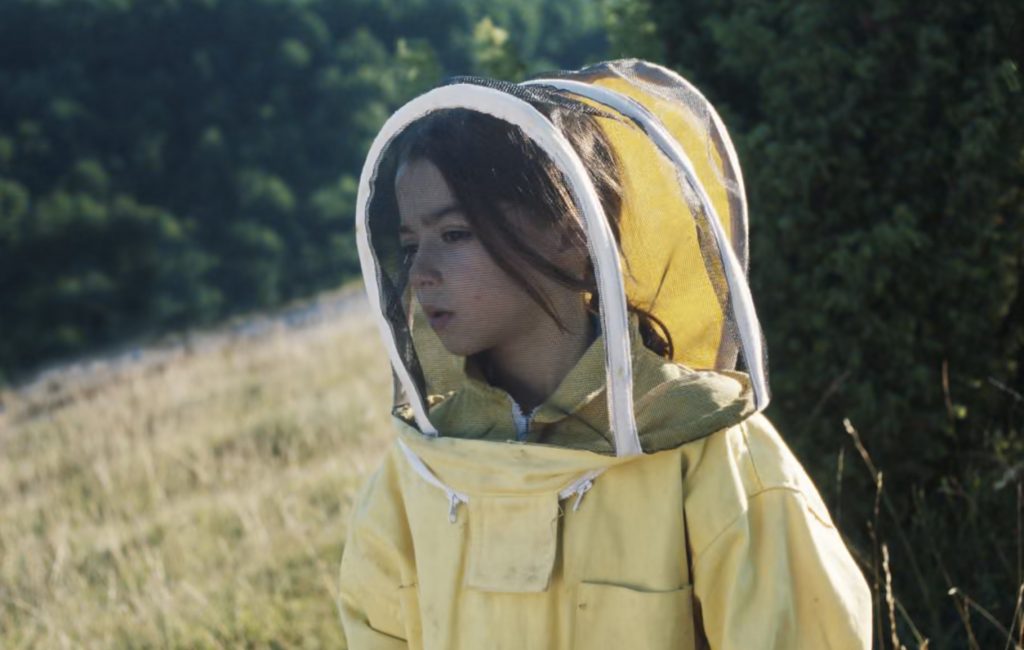
Challenges to gender fluidity and hive identity seen through innocent eyes
There are moments when a legal clarification does more than settle a point of law. It delineates, more quietly, the limits of what a culture is prepared to hold in suspension, and the degrees of innocent ambiguity within so-called “cultural norms” on taboo issues like child sexual identity, it is prepared to accept.
The recent UK Supreme Court decision on the definition of sex, followed in December 2025 by Girlguiding UK’s decision to exclude trans girls and young women from membership, has the feel of such a seismic moment. Not decisive, exactly. But narrowing. A drawing-in of the perimeter.
The language around both has been necessarily formal—clarity, safeguarding, proportionality. Words that close rather than open. Useful, but partial. What recedes, in their wake, is something less easily codified: the space in which uncertainty—particularly a child’s uncertainty—can exist without really needing to always declare itself absolutely.
It is in that diminishing space that two recent European films begin to feel less like cultural artefacts and more like counterpoints: L’immensità and 20,000 Species of Bees. Both concern children. Both concern them exploring their gender identity – or more specifically, the cold-clinical diagnosis of their ‘gender dysphoria’ – But neither film feels the need to concern itself with resolution:
L’immensità (2022) is an Italian-French Co-production set within the porous boundaries of a family under strain, it allows identity of the young biological girl Adriana/Adri/Andreu to emerge alongside fantasy, performance, and retreat. Its autobiographical inflection is evident, but never declarative. Memory, rather than argument, structures what we see;
In the Spanish film 20,000 Species of Bees (2023), the identity of the young biological boy Aitor/Cocó/Lucia is not announced but approached—hesitantly, iteratively, through gesture and misrecognition. The adults orbit, uncertain of themselves. Language lags behind experience. The film resists the gravitational pull of a needed moral conclusion.
Neither film is adapted from an existing text. That absence matters. These are not interpretations of an established narrative but acts of observation—constructed without the prior authority, or constraint, of publication. They arrive unanchored, and remain so.
What the films share is not a position, but a tolerance and delight: for acceptable uncertainty, for contradiction, for the possibility that a child’s sense of self can be simultaneously insistent and provisional. It begs the question: Is it inevitable that significant distress or discomfort need arise from any mismatch between a young person’s gender identity and their biological sex ‘assigned’ at birth? This in turn raises a further question that sits awkwardly in the present climate: Could either of these European films be made, as they are, within more conservative societies like Britain or the United States?
It is not that the subject is absent there. Quite the opposite. Gender identity – particularly in relation to children – has become one of the most visible and contested areas of our contemporary cultural life. But visibility has brought with it a kind of compression. Narratives tend towards absolute declaration. Positions are quickly inferred, then defended – particularly if vilified.
The figure of J. K. Rowling sits, inevitably, within such landscape, (particularly now her Harry Potter is to have a major TV series reboot on HBO Max later in 2026). Her own interventions on assigned gender have been unapologetic, sustained, widely amplified, and deeply divisive. What they have also done—regardless of where one stands—is to harden the terms of engagement. To make it increasingly difficult for any representation of gender variance or fluidity, particularly in childhood, to exist outside a field of alignment or opposition. That her books were directed to, and were so well received by all ages of children, is the ultimate irony here perhaps – That as well as the well-documented limited diversity and inclusion evident in the original film franchise, other than paid lip service.
But in such a context, such equivocation begins to look less like nuance and more like evasion. A refusal to resolve can also be read as a failure to commit.
The Girlguiding UK decision can be understood, in part, within that same narrowing. An established and much-revered organisation seeking legal coherence; a framework within which boundaries must be drawn. Yet when those boundaries intersect with childhood, they carry a different weight. Not because they are necessarily misplaced, but because they operate on lives still in formation: Protective, perhaps. Constraining, also. The two are not easily disentangled.
What is notable is how little of the surrounding discourse is able to remain with that tension. Coverage tends to move quickly—towards implication, consequence, precedent. Necessary movements, all. But they leave little room for something slower, less resolved.
This is where the contrast with less hamstrung European cinema becomes instructive, though not in any simplistic sense of difference. It is not that one tradition is more enlightened than another. Rather, that certain types of film—these films—retain a capacity to dwell, with a refusal to oblige the observer to have to judge. Children, in both, are not necessarily seen in their final positions. They are still very young and embroiled in an evolving process – one that can continue theoretically anywhere – including even reversion back to their biological starting point. The way is not preset and nor should it be.
That distinction feels increasingly difficult to sustain within Anglo-American contexts, where identity is more readily treated as something to be clarified, stabilised, and situated within established norms – and where non-standard deviations are often simultaneously cited alongside mental health and wellbeing issues. Even acts of empathy can take on a declarative quality. Experience becomes illustrative. Narrative becomes argument.
Filmmaking does not stand outside this. It is shaped by the same conditions—funding, distribution, reception. A work that declines to resolve its central question risks being read as incomplete, or worse, as evasive. Such open mindedness acquires a cost.
And yet it is precisely that deliberate uncertainty —particularly in relation to childhood—that these two important films insist upon. Not as an evasion, but as a form of attention. There is, perhaps, a quiet dissonance here. At the point where public debate is most intense, the forms that might allow for a more patient understanding of lived experience seem least able to circulate, at least in certain cultural spaces.
This is not a claim for cinema as remedy. Nor for European filmmaking as the exemplar necessarily. But it does suggest that something has shifted in what can be held, and for how long, before it must be resolved into position.
The law cannot accommodate such suspension. Nor, ultimately, can institutions. But culture has, historically, been able to. Illustratively-speaking, the navigation through time and culture of Robert Baden-Powell’s beloved ‘Scout Method’ has arguably now reached a seminal point – one where the single sex philosophy of Girlguiding UK leaves behind the opposite, innate inclusivity of The Scout Association. Political corrections addressing social media abuse, inequality, misogyny and gender violence have created an arguable overreaction calling for a safe space for only those born ‘biologically’ as girls. The continuing fall out from a post-Tate and Epstein ‘Manosphere’ has a part to play in further explaining this uncoupling – but the contrast between these two long-standing and admired children charities seems stark, and pretty sad looking forwards.
But the real irony comes when viewing explorations of gender identity through an affected child’s eyes. Whilst their view is often both uncertain and troubled, it can remain fundamentally unheard too. Their inherent innocence is not only in danger of becoming lost, it was arguably never found in the first place. Not through any fault on their part, but stirred-on by our increasingly judgmental society (as led by us so-called adults) to unnecessarily burden them with issues that could frankly wait a while.
In L’immensità, the self-identified Andreu frustratingly explains to his mother at one point: “I am not Adriana. You don’t have the power to fix me. I come from another galaxy”. Conversely, towards the end of ‘20,000 Species of Bees’, the young Cocó, alone in her moment of joyous epiphany finally proclaims aloud to the hives of her myriad of insect friends: “Bees, I am Lucia!” She had finally chosen her ‘real’ name after seeing a statue of the ‘miraculously immovable’ St. Lucia of Syracuse, who was martyred for resolutely standing up for her own beliefs.
Spain reportedly leads the world in progressive gender self-determination laws, so it seems fitting to permit this enlightened film, set in the rural idyll of its Basque Country, to have that last word here.
Whatever age we are, however alien we feel and whichever personal pronouns we might prefer, everyone should have the right to their own innocent taste of sweetness whilst young. Everything else can wait as life is too short. The bees know this.
Postscripts
While both Girlguiding UK and The Scouts Association share a foundation in the “Scout Method” created by Robert Baden-Powell—focusing on character development, citizenship, and outdoor skills—their modern ethos differs significantly regarding gender:
Girlguiding (Single-Sex Ethos): Operates on the belief that girls need a “safe space” just for them. The ethos is built on empowering girls to build confidence and “find their voice” without the social pressures or gender stereotypes often present in mixed-gender environments. It focuses specifically on the challenges and needs of girls today.
The Scouts (Inclusive/Mixed Ethos): Since 2007, The Scouts in the UK has been fully mixed-gender. Its ethos is centered on being “open to all,” aiming to reflect a diverse society where boys and girls learn to collaborate as equals. It promotes shared values of integrity, respect, care, and belief across all genders.
Notes on the Films Cited
L’immensità (2022 Italy, dir. Emanuele Crialese)
Original work with autobiographical elements. Set in 1970s Rome, following Adriana/Adri/Andreu within a fracturing family environment. Starring Penélope Cruz with Luana Giulian as Andreu. Premiered at Venice. Praised for emotional ambition and performance; responses divided on its tonal shifts between realism and fantasy.
20,000 Species of Bees (2023 Spain, dir. Estibaliz Urresola Solaguren)
Original screenplay. A child, Aitor/Cocó/Lucia navigates gender identity within an extended family over a summer in the Basque Country. Premiered at Berlin, where Sofía Otero received the Silver Bear for Best Leading Performance. Noted for its restraint and attentiveness; occasionally criticised for its deliberate, unresolved structure.
Notable Films in Similar Genres
Tomboy (France, dir. Céline Sciamma)
Perhaps the closest tonal companion to 20,000 Species of Bees. A child passes as a boy over one summer. Quiet, observational, and notably unresolved.
Ma vie en rose (Belgium/France, dir. Alain Berliner)
Earlier, more overtly framed, but still centred on a young child’s insistence on identity. Notable for the social response surrounding the child.
XXY (Argentina, dir. Lucía Puenzo)
Slightly older protagonist (early teen), intersex rather than trans, but similarly concerned with bodily autonomy, parental pressure, and indeterminacy.
Girl (Belgium, dir. Lukas Dhont)
Moves into adolescence and is more physically explicit. Critically acclaimed but also contested—useful as an example of where ambiguity gives way to more directed narrative.
A Kid Like Jake (USA, dir. Silas Howard)
One of the few recent US films centred on a gender-nonconforming child. Notably framed through the parents’ anxieties rather than the child’s interiority.
Transparent (USA)
Primarily adult-focused, but its flashbacks to childhood identity are telling—often more tentative and exploratory than the present-day narrative.
Boys Don’t Cry (USA, dir. Kimberly Peirce)
Important but firmly adult, and tragic. Its cultural weight arguably shaped the more declarative tone of later Anglo-American storytelling.
Euphoria (USA)
Includes adolescent trans experience (Jules), though stylised and less observational. Again, identity is narrativised quite explicitly.
George (USA)
A middle-grade novel about a trans girl. Clear, affirming, and widely used in schools—important, though more resolved in tone than the films you reference.
Teen-focused, dual narrative. Again, tends toward resolution and identity confirmation.
Felix Ever After (USA)
Older young adult, but notable for exploring fluidity and uncertainty within identity itself.
Orlando (UK)
Not about childhood, but foundational in its fluidity of identity. Its tone—playful yet unresolved—feels closer to European cinematic approaches.
The Left Hand of Darkness (USA)
Again not about children, but crucial in decoupling gender from fixed categories. Often cited, rarely matched in subtlety.
Middlesex (USA)
Intersex narrative beginning in childhood. More explanatory, but still attentive to complexity over time.
Petite fille (France)
A documentary about a trans girl. More explicit than Tomboy, but still careful and observational.
Close (Belgium, dir. Lukas Dhont)
Not about gender identity directly, but about boyhood, intimacy, and the policing of identity—highly relevant in tone.
The Falling (UK, dir. Carol Morley)
Adolescent girls, hysteria, embodiment—less about gender identity, more about how young identity destabilises.
Playground (Belgium)
Childhood subjectivity rendered almost entirely from the child’s perspective—formally useful as a comparison.
Categories: Journaling