Atoll journal (co-writen with Google Gemini, uploaded 18th July 2026) explores the growing movement of Rights of Nature and acknowledgement of the sentience of our rivers celebrated over millennia – through both ancient and modern public art installation.
Riverine Goddesses & Tales of the Riverbank
This September marks the 50th anniversary of the publishing of the novella ‘A River Runs Through It’ by Norman Maclean. In it he describes his becoming haunted by waters “cut by the world’s great flood and runs over rocks from the basement of time”. It is a seminal book for me that started (after the Robert Redford film adaptation) my love for fly fishing rivers, and since morphed into an even greater, almost divine, riverine joy.
Linked to this, my day-to-day architectural and public art practice has also always been interested in the historical threshold where human activity meets environmental place. Our landscape are not a passive canvas, but a moveable feast and (to an increasing many), a living, sentient collaborator with all life forms going back millennia.
This simple belief is also beautifully captured in the public art work of Barcelona artist Jaume Plensa and his monumental ‘Water’s Soul’. Placed permanently on the Jersey City waterfront in 2020, his 80-foot-tall bust of a matriarch made from fiberglass, resin and white marble dust holds her finger to her lips, gazing out over the world-famous Hudson River. She acts as it’s visual anchor there and looks to elicit a collective pause taken there in reverential silence. Her “Gesture for Quietude”, as Plensa described it, is a gentle request, urging us all to look past the urban clutter and listen to the silent, profound voice of the water and to the human history (good, bad and indifferent) that it has witnessed over time.
The historic industrialisation of the Hudson River and (literally) that whole different ‘ kettle of fish’ that is Norman Maclean’s Clark Fork River and Big Blackfoot of Missoula are of course wholly different, but both share significant struggles with human co-habitation: The Hudson with its great population catchment and industrial hinterland has unsurprisingly suffered the most contamination and sewage pollution with habitat loss, but rivers in Montana too have suffered from population and recreational growth, as well as logging and sedimentation, and copper mining booms – with consequent heavy metal contamination. Today, both catchments show positive ecological outlooks through targeted restoration: The Hudson continues to benefit from dredging Superfund sites and improved sewage management, aiding species like the Atlantic sturgeon; whilst Montana rivers like the Blackfoot thrive on collaborative habitat restoration and watershed management, boosting native trout.
But Jaume Plensa sees his ‘Waters Soul’ not just as a localised work to unite the city of Jersey City and New York City, but as a call for global action for all water that he sees as “the most public space in the world”. Like many of Plensa’s previous marble monolithic heads, (‘Dream’ in St Helens 2008; ‘Echo’ in Seatle 2011; and ‘Behind the Walls’ in Michigan 2018), ‘Water’s Soul’ stands as a reminder that our shared belonging connects humanity, serving as a placeholder for our collective memories.
His concept for ‘Water’s Soul’ of course aligns perfectly with the rising dialogue surrounding the ‘Global Alliance for the Rights of Nature’ movement and the sentience of freshwaters and the granted legal personhood to several of the world’s most ecologically vital and culturally sacred rivers – including the Atrato River (Colombia 2016); Whanganui River (New Zealand 2017); Ganga and Yamuna Rivers (India 2017); and Magpie River / Mutuhekau Shipu (Canada 2021).
In his landmark book, ‘Is a River Alive?’, author Robert Macfarlane also answers the title’s question with a resounding yes. He highlights global legal shifts that treat water systems as living beings rather than commodities. Echoing this perspective, Amy-Jane Beer’s award-winning book ‘The Flow: Rivers, Water and Wildness’ explores our deep emotional bonds with river networks. She frames water as a vessel for healing and personal discovery.
When we tap into this current, we recognize ourselves as part of the ‘Riverkin’—a community bound by shared riverine hydrology. These interconnections were captured in Seamus Heaney’s evocative poem, ‘The Riverbank Field’. In it, Heaney weaves local topography with classical imagery. He portrays the riverbank as a gathering place for spirits waiting to drink from the water to shed their past memories. The lines show a deep awareness of any river’s life-giving power:
This fluid sentience is not a modern artistic invention, nor one restricted to aboriginal cultural influence. It is simply a rediscovery of ancient truths we knew before time but have forgotten.
Plensa’s white goddess on the Hudson stands as it’s contemporary guardian with a global outlook. But she simply shares the same lineage with the far less known and reported Roman-Celtic goddess called Verbeia. Worshipped at the Roman fort in Ilkley, West Yorkshire, Verbeia is said to have been the literal deification of the River Wharfe itself. A historic altar stone found at the site shows her holding two snakes. These figures symbolize the winding, dangerous currents of the river’s paths.
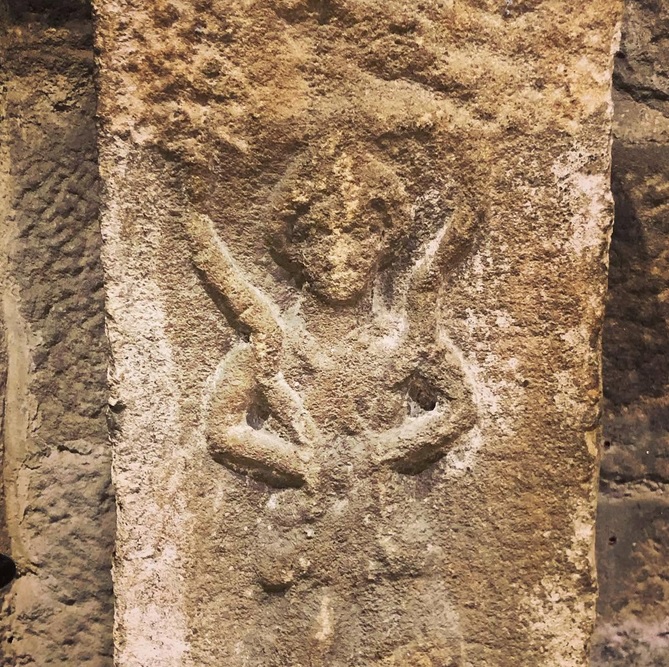
Whether anciently carved in Yorkshire gritstone or moulded in modern polyester resins, these figures point to the same truth: our waters hold a spirit that requires our attention.
At Atoll, we continue to channel these connections through our work. We challenge developers, artists, and communities to listen closely to the rivers that shape our built world.
Water’s Soul, 2020 was commissioned by the LeFrak Organization Inc. and Simon Property Group Inc., the developers of the Newport residential complex that helped transform the waterfront on the New Jersey side of the Hudson.
Verbeia The Goddess of Wharfedale, her Roman Fort, also known as Verbeia, was originally built from timber from around 80 AD at the position of an important safe ford across the treacherous River Wharfe at Ilkley.
Categories: Journaling