Atoll journal (co-writen in part with Google Gemini AI, and uploaded 18th July 2026) explores the growing momentum of a ‘Rights of Nature’ movement that acknowledges the sentience of our rivers – celebrated over millennia, but in modern times forgotten. It illustrates the slow rediscovery of a concept based more on a sense of ‘deep time‘, and using two contrasting examples of cultural iconography that link so-called ‘river personhood’ – but which are set two thousand years apart. This journal accompanies the Wide Sargasso Sea piece highlighting the current travails of the River Wye written in August 2025.
Haunted by Waters and Fluvial Spirits
A world premier, commissioned by Opera Montana, in September 2026 marks the 50th anniversary of the publishing of the novella ‘A River Runs Through It’ by Norman Maclean, set in 1930’s Missoula. In it, he recounts the true tale of himself and his younger brother Paul, raised in a strict Presbyterian household, led by their father a practicing Minister, and being bound by their holy trinity of family, faith, and fly fishing the majestic trout streams of Western Montana. Maclean famously reflected: “In our family, there was no clear line between religion and fly fishing”. But discovery of his writings marked my own epiphany in confirming (after first discovering them via the 1992 Robert Redford film adaptation of his short story, and already being an avid reader of Ernest Hemingway’s novels and his early ‘cub reporter’ journalism) my own absolute love for the art and beauty of fly fishing. Like Maclean’s own experience, the passion quickly expanded for me into an almost divine reverence for our wild rivers.
Set on a parallel track, my own collaborative architectural and public art practice (that has been in operation in one form or another for over 40-years), has also become fascinated with the historical and cultural thresholds where human activity meets and reveres environmental place. Our shared landscape is not a passive canvas, but a moveable feast (to quote Hemingway this time) and, to an increasing many, is a living, sentient collaborator with all life that is timeless.
This same pure belief is arguably captured in the public art practice of Barcelona artist Jaume Plensa, and in particular his monumental installation called ‘Water’s Soul’. Placed permanently on the Jersey City waterfront in 2020, (not far from the 2026 FIFA World Cup final MetLife Stadium in East Rutherford), his 80-foot-tall bust of a woman, cast in fiberglass, resin and white marble dust, holds a finger to her lips with eyes closed whilst facing Manhattan across the world-famous Hudson River. Here she acts as its visual anchor and looks to elicit a collective pause of reverential silence. Her universal “Gesture for Quietude”, as Plensa has described it, is a gentle request, urging us all to look beyond the urban jungle and listen to the profound voice of the water – and indelibly connected to that, all the human effects (good, bad and indifferent) that it has endured over time. But despite public popularity, the work has faced some artistic criticisms too: whether claims of over-commercialism; being an Instagram-Friendly Cliche; or just Plensa’s repeated use of his rehashed artistic motifs, that use his formulaic style over more site-specific content. It is all subjective of course, but my other articles on public art in the burgeoning commercial realm of ‘Privately Owned Public Space’ (POPS) of New York in ‘West Side Storey’ and ‘Won’t You Be My Neighbour?’ also explore similar cultural criticisms.
In comparing the historic industrialisation of rivers like the Hudson and Norman Maclean’s Clark Fork River and Big Blackfoot, these are wholly different ‘ kettles of fish’ (literally). But all share significant historical struggles with their human co-habitation: The Hudson with its great population catchment and industrial hinterland has naturally suffered the most contamination and sewage pollution with habitat loss. But the rural rivers of Western Montana have struggled too following population and recreational growth, as well as from sedimentation linked to logging, and heavy metal contamination from copper mining booms. Today, like many others, these rivers offer some positive ecological outlooks through their various programmes of targeted restoration: For example, the Hudson continues to benefit from dredging Superfund sites and improved sewage management, aiding species like the Atlantic sturgeon; whereas rivers like the Blackfoot, thrives on collaborative habitat restoration and watershed management, boosting native trout.
Despite the voiced criticisms, Jaume Plensa sees his ‘Waters Soul’ not just as a localised work of cultural marketing, used to unite the shared river frontage of Jersey City and New York City, but as a call for a global action for all water – which he describes as being “the most public space in the world”. Like many of Plensa’s other monolithic heads, (‘Dream’ in St Helens 2008; ‘Echo’ in Seatle 2011; and ‘Behind the Walls’ in Michigan 2018), his installation here stands as a reminder that shared belongings connect our humanity, and serve as a placeholder for collective memories.
His artistic point here aligns perfectly with the rising dialogue surrounding a movement called the ‘Global Alliance for the Rights of Nature’ . This advocates for recognition of a ‘sentience’ of all of our ecosystems and biospheres – including their trees, oceans, animals, mountains and freshwaters. Indeed, some of the world’s most ecologically vital and culturally sacred rivers already hold granted legal personhood. These include the Atrato River (Colombia 2016); Whanganui River (New Zealand 2017); Ganga and Yamuna Rivers (India 2017); and Magpie River / Mutuhekau Shipu (Canada 2021). Linking this, a Universal Declaration of River Rights also calls for us all to sign their global declaration in support. Even in the UK, a March 2026 Rights of Rivers research briefing, lodged in the House of Commons Library, outlines the very same concept through a series of case studies – in exploring similar implications were the UK ever to formally adopt such rights.
In his landmark book, ‘Is a River Alive?’, the brilliant Robert Macfarlane answers his own title’s question with a resounding “yes”. He highlights global legal shifts that treat water systems as living beings rather than commodities. Reiterating further, and linked to the ‘Right to Roam’ movement, his ‘Riversong Ebb and Flow’ adds what he calls his “broadside ballad” to further protest about the slow death of rivers in both the UK and around the world, and sings for their revival. Macfarlane’s evocative ‘call to alms’ rouses us all to take a stand against against the fat-cat ‘Water and Sewerage Companies’, reminding us sadly that the “suits and boardrooms make ghosts of Gods turned River Songs to eligies”. He sees it as a wonderful and free-to-use choral ballad for all of our waterways (see the Youtube extract below hosted by River Action UK).
Echoing this perspective, Amy-Jane Beer’s book ‘The Flow: Rivers, Water and Wildness’ also explores similar deep bonds with our rivers. In it, she writes movingly about her friend Kate who died in a kayaking accident on the River Rawthey in Cumbria in 2012. Beer frames wild rivers and water as an emotional journey and vessel for both our collective healing and personal discovery. She asks: “What is a river? If you ask me now, I’d say it is a path… It’s a circle you might never complete, but if you keep going long enough you’ll be back somewhere close to where you began”. Again, I am drawn to remembering Hemingway, and his short story ‘Big Two-Hearted River’. Here his protagonist Nick Adams, employs the rhythm of his solo fly fishing and camping trip to the trout stream of the same name in Michigan’s Upper Peninsula. But the title is also a metaphor to his need to heal himself after severe trauma serving in the First World War. His is an emotional and psychological journey of recovery.
Similar spiritual powers of restorative mindfulness are invoked in the work of many of our great poets of course – such as Ted Hughes in his evocative 1983 poetry collection called ‘River’. From this, in his poem ‘The River’, he says of it: “It is a god, and inviolable. Immortal. and will wash itself of all deaths”. Like Macfarlane and Beer, Hughes’ writing also explored the raw, cyclical, and spiritual power of rivers and nature. It too was inspired by his lifelong passion for fishing and the British landscape. His poetry symbolises their primal energy, the passage of time, and the fragile, sacred connection between humanity and the natural world.
But any awareness of a poetic sentience is not just modern artistic recognition, nor one restricted to indigenous aboriginal culture either. It is simply a rediscovery of ancient truths that we perhaps all intuitively should know, but have long forgotten. So today, as we tap into our new ‘stream of consciousness’, we find ourselves as part of a rediscovered movement of environmental ‘kinship’. It is part of a new zeitgeist that researchers and artists at the interdisciplinary Water@Leeds University are calling ‘Riverkin’. Their Water Value Research Group continue to look to “explore our relationships with rivers” they say, with the aim of restoring the reciprocal, nurturing attitudes we previously once held for them, and now often take for granted. This thinking involves the growth of new model communities, such as those established in 2022 around the Nidd Action Group in Knaresborough. These new communities are brought together by a shared sense of ecological empathy, to be informed by new models of riverine management knowledge and engaged in shared, intergenerational actions.
That Plensa’s own monumental white goddess, placed overlooking the Hudson, stands as a contemporary guardian with an outlook demanding a new global vision is a given. But in doing so, she simply shares the same lineage as a modest, little-known and unassuming Romano-Celtic goddess called ‘Verbeia’ – first sited on the banks of the River Wharfe in West Yorkshire around two thousand years earlier. Worshipped at the Roman fort in Ilkley, ‘Verbeia’ is said to have become the literal deification of the river here. A carving on a historic altar stone found at the site shows her embracing two snakes. Some say her serpents symbolise the sinuously winding embodiment of the Wharfe with its eerie and dangerous beauty.
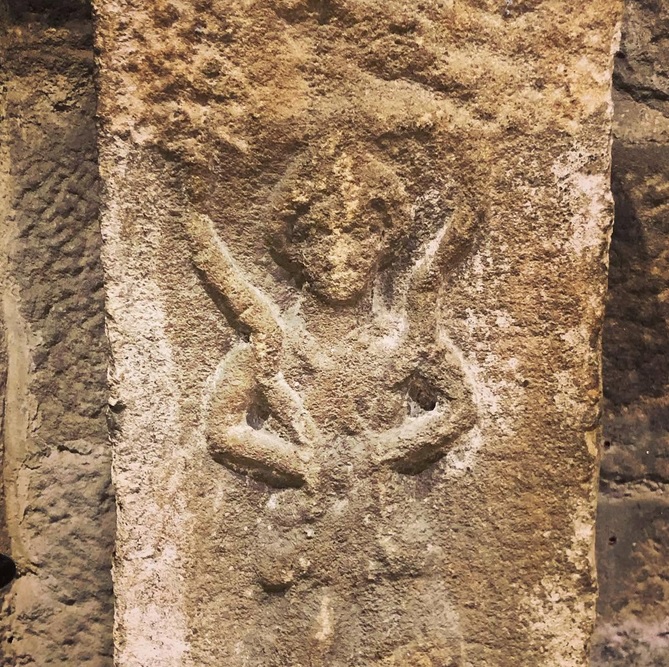
Arguably, it has taken millennia from this adoption of ‘Verbeia’, for another community-culture engaged version of Riverkin to finally emerge again on the upper Wharfe: Precursor to the Nidd Action Group, Ilkley Clean River Group was first established in 2018 to front a prominent, grassroots community campaign dedicated ostensibly to eliminating sewage pollution in the river whilst securing it legally as a shared public space (to borrow Jaume Plensa’s words). Encouragingly, this effective offering made to Verbeia of a Rights of the River Wharfe’ also declares their intent to now act as the river’s community guardian in perpetuity. Organisation, the Yorkshire Dales Rivers Trust with its various educational and engagement programmes like their recent Rivers4Life initiative, extend such guardianship across it’s greater Dales river catchment.
And so it is, whether moulded in modern polyester resin or anciently carved in Yorkshire gritstone, the two fluvial spirits of ‘Water’s Soul’ and ‘Verbeia’ .help point us to the same hidden truth: That whilst our waters might indeed hold a spirit to watch over us, in doing so, they still require our quiet attention and a gentle, grateful servitude in exchange.
In my own very modest way, I continue to channel similar holistic ambitions to ‘pay-it-forward’ environmentally speaking through my own pro-bono and voluntary work. In doing so, through my work, writing and social media, I also try to encourage clients, developers, artists, and communities alike to listen to the waters that share our lives and shape our world – and be seen to do something about it. But in my having learnt to advocate for this, I must pay homage to certain seminal works discovered along the way: Like the evocative ballad of Robert Macfarlane’s ‘Riversong’ only recently discovered, as well as ultimately to Norman Maclean’s famous final ‘Word’ blending his river physiography with theology (made, I heard him explain in an old radio interview, in direct challenge to his father’s interpretation of the Gospel of St John, with it’s famous opening line of: “In the beginning was the Word, and the Word was God”). Maclean saw his own personal river deity differently and summed it up at the end of his novella in his own unequivocal style:
“Eventually, all things merge into one, and a river runs through it. The river was cut by the world’s great flood and runs over rocks from the basement of time. On some of the rocks are timeless raindrops. Under the rocks are the Words, and some of the Words are theirs. I am haunted by waters.”
Ian Banks, 18th July 2026
POSTSCRIPT NOTES
Ian Banks has had a deep love of river fly fishing (for wild Trout & Grayling) that goes back over 40-years following an introduction to it via a love of the fiction and journalism of one Ernest Hemingway that first began in 1984. It was later compounded on discovering Norman Maclean’s ‘A River Runs Through It’ in 1992. Linked to his growing passion, since 2016 he has also volunteered as part of a nationwide ‘citizen science’ programme called The Riverfly Monitoring Initiative (RMI) run by The Riverfly Partnership. His allocated invertebrate monitoring sites during all of that time has been along ‘Verbeia’s’ River Wharfe upstream of Ilkley at first Buckden and later Addingham.
Water’s Soul, 2020 was commissioned by the LeFrak Organization Inc. and Simon Property Group Inc., the developers of the Newport residential complex that helped transform the waterfront on the New Jersey side of the Hudson.
Verbeia The Goddess of Wharfedale, her Roman fort of Olicana, (also referred to as ‘Verbeia’), was originally built from timber from around 80 AD at the position of an important safe ford across the infamously treacherous River Wharfe at Ilkley. An altar stone dedicated to her by Roman soldiers was reportedly discovered at Ilkley sometime before 1600. It was found near the known site of their fort.
Opera Montana is celebrating the 50th anniversary of Norman Maclean’s iconic 1976 novella, A River Runs Through It, by staging its first-ever commissioned work: a brand-new operatic adaptation by Zack Redler, Matt Foss, and Kelley Rourke. The world premiere is scheduled for September 18 2026 brings to life with sweeping music and cinematic storytelling. It follows two brothers bound by family, faith, and fly fishing. You can listen to Norman Maclean’s own voice reading from ‘A River Runs Through It and Other Stories’ by exploring archival recordings available on the Studs Terkel Radio Archive.
Riversong Ebb & Flow: Illustrated Youtube video features Riversong performed by Rob McFarlane. Directed by Charlotte Sawyer. Hosted on River Action UK. Footage generously provided by: Blue Marine Foundation; Greenpeace; Rave On For The Avon Documentary by Charlotte Sawyer;The Angling Trust; RSPB; Richard Brooks Lightning Strike Productions; “Swim Club” Brass Mill Media, Diverse City and The Mowlem Theatre. Supported by The Space and Arts Council England with funding from the National Lottery.
OTHER NOTES
Ilkley Clean River Group: Concerned over regular storm overflow of sewage spillage into their stretch of the River Wharf, the Ilkley Clean River Group was first founded by local citizens to liaise with the relevant authorities and other interested organisations and held public meetings, meet their MP and sent out press releases. They ultimately decided though that the best way to bring the problem to the attention of the public was to apply for bathing water status – which if acheived would require the Environment Agency to sample the water and test it for certain types of pollution. this group finally made history in 2020 by securing the UK’s first-ever inland designated bathing water status for the Wharfe at a site just downstream of the town, (granted by the UK government’s Department for Environment, Food and Rural Affairs). Success has since resulted in the declaration and public uptake of their ‘Rights of the River Wharfe’.
Water@Leeds / Riverkin: Established in 2009, water@leeds is one of the largest interdisciplinary centres for water research in any university in the world. It draws together over 500 academics and postgraduates from across the University of Leeds to deliver excellent, internationally leading water science, technology and policy research. As part of this, the Water Value Research Group explore our relationships with rivers, with the aim to restore the reciprocal, nurturing attitudes we previously held for them, coining the term ‘Riverkin’ to illustrate this positive relationship of kinship to rivers. In their paper titled: “Riverkin: seizing the moment to remake vital relations in the UK and beyond”, they argue that the UK and Europe can and must re-ignite our kinship with rivers to resolve the critical challenges that they (and so, we) are facing.
Rivers4Life: Set in the Yorkshire Dales, the 3-year Rivers4Life project enables the Yorkshire Dales Rivers Trust work with schools and communities along their rivers catchments of Wharfe, Swale, Ure, Nidd and Ouse, and tributaries. Through the project they are collaborating with artists to inspire children and communities about everything to do with rivers and wildlife using the arts to connect with new audiences, and extending their education and engagement programmes.
Rights of Nature: There are growing environmental and community movements in the UK calling for the recognition of our rivers as sentient beings – and so, looking to grant them (and other key natural environments) ‘legal personhood’. This is not a new cultural phenomenon though, as many indigenous cultures around the world have subconsciously known this for millennia. Our own ‘Rights of Nature’ / ‘Rights for the Rivers’ movement has a long way to go still in the UK, but at least public and political awareness around flood mitigation, sewerage outfalls, agricultural and chemical pollution, and sustainable urban drainage is growing nationally. Earth Law Center runs an initiative to define the basic rights to which every river is entitled: the Universal Declaration of River Rights. You can read about it here and read and sign the declaration here.
Pantheon of Other River Deities in the UK: Ancient Britons viewed rivers as living, conscious entities, frequently naming the water after the goddess or god who embodied it. Notable from these, and in addition to Verbeia of the River Wharfe, include:
- Sabrina (River Severn): Arguably the most famous native UK river goddess. In legendary British history, she was a princess drowned in the waters who subsequently became the divine spirit and ruler of the River Severn;
- Old Father Thames (River Thames): The personified deity of London’s primary waterway. Represented as a venerable, bearded river god symbolising abundance, physical statues of him can still be found at Somerset House and Ham House;
- Clota (River Clyde): The ancient patron goddess of Scotland’s River Clyde. She was worshipped as a powerful provider and cleanser for local tribal communities;
- Abandinus (Cambridgeshire): A strictly localized Celtic river god worshipped at a Roman fort in Godmanchester. He is known from a single inscribed altar stone and was likely the spirit of a nearby stream;
- Belisama (River Ribble / River Mersey): A major Celtic goddess of lakes, rivers, and craftwork. Roman geographer Ptolemy mapped her name directly to an estuary in North West England, likely the River Ribble or Mersey.
River Deities Globally: These tend to carry massive theological weight because early human civilisations depended entirely on predictable river behaviour for agriculture. They include notably:.
- Ganga (The Ganges, India): The most widely revered river deity in the world;
- Hapi & Anuket (The Nile, Egypt);
- Achelous (The Achelous River, Greece): In Greek mythology, king of all the Potamoi (river gods);
- Chalchiuhtlicue (Central Mexico): The Aztec goddess of all horizontal sweet waters;
- Hebo (The Yellow River, China);
- Tano (The Tano River, Ghana): A primary war and earth god in Akan mythology.
Categories: Journaling