Atoll journal uploaded 05 August 2026 describes the current and historic background to the monumental memorials in the U.S Black Hills, that are the four famous Presidents of Mount Rushmore and the lesser-known depiction of Crazy Horse on nearby Thunderhead Mountain.
It is an ironic morality tale and antonym of two polar opposites in the famous, sacred ‘Pahá Sápa’ of South Dakota: One relates to the well-known Narcissistic Personality Disorder of a sitting U.S President, who as a draft-dodger, gold-digger and serial liar, still seeks his unworthily immortality caved onto the face of the ‘Shrine of Democracy’ that is Mount Rushmore – despite it being neither justifiable, feasible nor ever-likely. The other relates to the unassuming modesty and quiet dignity of a famous, indigenous Northern Plains Native American war hero, who shunned the limelight throughout his life, but who died as a result of his Governments’ lust for gold over their basic cultural morals – and yet still ended up personified, by having his face slowly carved on the rock face of Thunderhead Mountain over the last 78-years.
Prologue: Heroic Failure and Little Bighorn
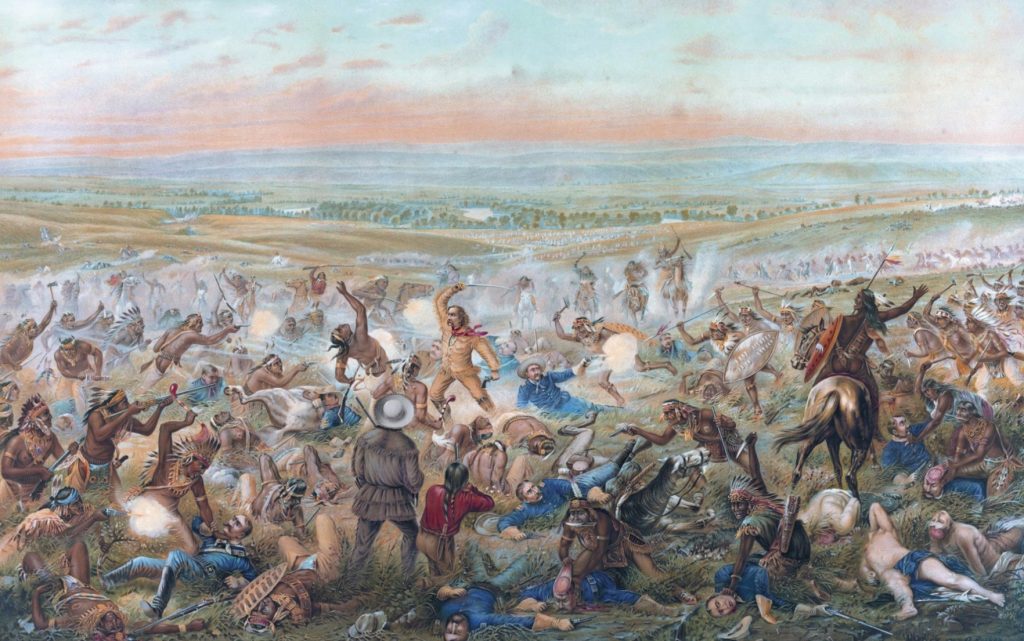
As the United States celebrated its Semiquincentennial on 4 July 2026, another important anniversary a hundred years younger passed earlier on 25-26 June. This marked the 150th year since the legendary Battle of the Little Bighorn of 1876 was fought and lost by the U.S Cavalry. Less well known to modern generations perhaps, this epic standoff between ‘Cowboys and Indians’ is embedded in the psyche and iconography of my boyhood generation of baby boomers brought up on their staple of old Westerns.
Here, the dashing, blond “Indian Fighter”, Lieutenant Colonel George Armstrong Custer of the 7th Cavalry and all of his detachment column of 210 men died valiantly when cut off and circled by in excess of 2,000 Lakota Sioux and Cheyenne warriors. As part of ‘The Great Sioux War’, Custer had been in pursuit of Sitting Bull, the spiritual and political leader of the wider Sioux nations of the Great Plains. But it was his second in command, the younger Crazy Horse who functioned as his tactical military leader and “shirt wearer” in the infamous battle. What followed was one of the most controversial fights in U.S. history – as it is notable for both the tactical astuteness and superior fire power of Crazy Horse, as well as the arrogance and heroic failure of the previously invincable Custer. The death at ‘Custer’s Last Stand’ of the so-called “Yellow Hair”, (as he was known by the Cheyenne and Arapaho tribes), was to go down in infamy and became a thing of Western folklore.
To Speak with Forked Tongue
The constructed Hollywood metaphor of the idiom “Pale Face speaks with forked tongue” rightly belongs to the category of binned racism of ‘Pseudo-Native-American’ or ‘Noble Savage’ tropes of so-called “Red Indians”, now happily long lost. Rather ashamedly, it is the stylised, generalised imitation of Indigenous speech once popularised by the 20th-century Western staples like Errol Flynn as Custer in ‘They Died with Their Boots On’ (1941). However, ignoring this lazy cultural appropriation, the meaning itself of the ‘White Saviour’ being in power whilst being duplicitous, hypocritical, and lying of course holds truth both historically as well as today – even if the metaphor used of a “forked tongue” dates back centuries to a literary tradition more influenced by biblical imagery of a serpent engineering the loss of Eden from innocents.
It would be nice to think we are long past such Christian obsession over moral temptation, but perhaps not in the current case of a apparently new and ungovernable ‘Wild West’ of America, as seen today more than 250-years on. As it celebrated the latest important anniversary of the signing of the Declaration of Independence, the Government of President Donald J. Trump appears to be acting with an increasingly disingenuous, self-serving impunity that appears at least to encourage and reward his financial conflict-of-interests personally. Critics argue that Trump has “blurred his public duties with his family’s personal profit-making activities.” Senator Elizabeth Warren (more of her later), even requested Department of Justice inquiries into this, and accused him of both picking the pockets of American consumers and profiteering off the crypto industry using “brazen crypto corruption”. In July 2026, a 927-page report of the US Office of Government Ethics, confirmed that, Trump made more than $2.2bn in the first year of his second term alone, benefiting from a vast global network of businesses and investments. In his co-authored book ‘Art of the Deal’, he talked of “truthful hyperbole” being used an “innocent form of exaggeration”. It’s purpose is to play to public fantasies and generate excitement rather than state strict facts, he said. “Truth isn’t truth”, his disgraced former legal adviser Rudy Giuliani also once claimed about him.
Ironic then that the 1776 Declaration of Independence contains the famous phrase “We hold these truths to be self-evident”, whilst the text of the U.S. Constitution still omits the word “truth” all together – even though it has had 27 Amendments since being first signed in 1787.
Perhaps then there can be no surprise then that this incumbent POTUS’s approach to his broader ‘Truth Social’ is deliberately manipulated too – often being characterised by Trump’s repeated dismissal of “Fake News” of political conspiracy in favour of a smokescreen of populist, Republican narratives. In doing this, he also regularly frames American history through his traditional White, European, and Christian nationalist lens: Most famously evidenced when he once publicly claimed of the pioneer settlers, that “our ancestors tamed a continent”. Add to this his dismissing of Senator Warren’s claim of native ancestry “They call her Pocahontas”, spoken whilst he stood directly beneath a portrait of President Andrew Jackson – the architect of the infamous forced Indian Removal Act and Trail of Tears.
No surprise then that his ongoing priorities are of ‘Dismantling Diversity, Equity, and Inclusion’; ‘Civil Rights Enforcement’; and ‘Immigration and Border Control’ using bodies like The Department of Homeland Security and Immigration and Customs Enforcement (ICE). The sense of an approaching dystopia and fall of a once democratic Empire (one that famously inspired the French Revolution) seems real and imminent. It used to be that ideas of Enlightenment could overthrow entitled Kings, but seemingly not here – at least not right now.
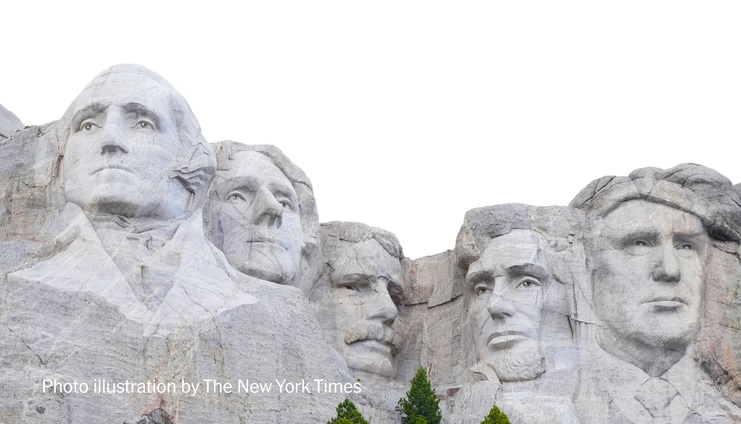
Then, like all vainglorious dictators, Trump is desperate for his absolute power to be replicated across the land using his name, face and architecture. Whether his grand “Trumphal Arch”, White House Ballroom or in etching his name or likeness onto civic and cultural institutions, it all accounts to being the same vanity project. His ultimate of course would be the realisation of a vision expressed to South Dakota Governor Kristi Noem early in his presidency, that having his face also carved onto the face of Mount Rushmore National Memorial was his “dream.” Hopefully, him seeing himself a worthy contemporary to stand for posterity alongside great Presidents Washington, Jefferson, Roosevelt, and Lincoln will remain his pipe dream forever. Despite this, Republican lawmakers have still attempted to introduced measures, such as a Congress Bill as recently as January 2025, directing the National Parks Service to explore the addition of his likeness on the monument. At the time of writing, that Trump may be currently more preoccupied with his plans to destroy a mountain of hard granite on Pickaxe Mountain in Iran is perhaps the saddest irony.
Take Me Back to the Black Hills
But it seems Mount Rushmore, like it’s strategic position in the Black Hills mountain range, is forever set to court controversy and be linked to an undermining of indigenous native American tribes. Doris Day in Calamity Jane in 1953 had once sung to be taken back to the beauty of the “Black Hills of Dakota”, but her historical portrayal, and that of Wild Bill Hickok in the film musical, also undermined that with its dismissive portrayal of the savage “Injun Country” that she loved. This is a stereotype that has persisted.
That the Black Hills, (from the literal Lakota Sioux translation of Pahá Sápa), are a series of sacred pegmatite granite landmarks spanning across western South Dakota and parts of northeast Wyoming, within the strict Lakota reserve, is still conveniently overlooked. They are seen to this day by the Lakota as being at “the heart of everything that is”. Pahá Sápa overlooks all of their sacred areas and burial grounds. Also part of this sacred reserve, the name of Mount Rushmore is an unsurprising political affectation too. Actually named Tȟuŋkášila Šákpe Pahá in Lakota language this translates to “Six Grandfathers Mountain”. That name represented the six sacred directions of their universe of West, East, North, South, Above (the sky/heavens) and Below (the earth). Forgotten by seemingly all but the Lakota perhaps, their mountain was part of the illegal land grab, when the U.S. government seized all of the sacred Black Hills region back from the Sioux Nation in 1877 after gold was discovered. In doing so, the Government violated their own Fort Laramie Treaty of 1868. In this, the U.S government had already guaranteed the Black Hills to the Sioux in perpetuity. The Treaty supposedly closed the territory to white settlement “for as long as the river flows and the eagle flies”.
Desecration of a Sacred Mountain or New Shrine of Democracy?
It proved to be a meaningless guarantee, with the altruism violated when gold was suddenly discovered in the hills and the Black Hills Gold Rush in 1874 ensued. The source of that discovery was the military expedition of Lieutenant Colonel Custer no less. His death soon-to-come in battle at Little Bighorn of course followed this initial spark to ignite The Great Sioux War of 1876-77. The winter campaign of the relentless U.S. Army destroyed indigenous camps, cutting off food rations, and forced mass surrenders. Once ratified, agreement and military appropriation was to be enforced within 3 years.
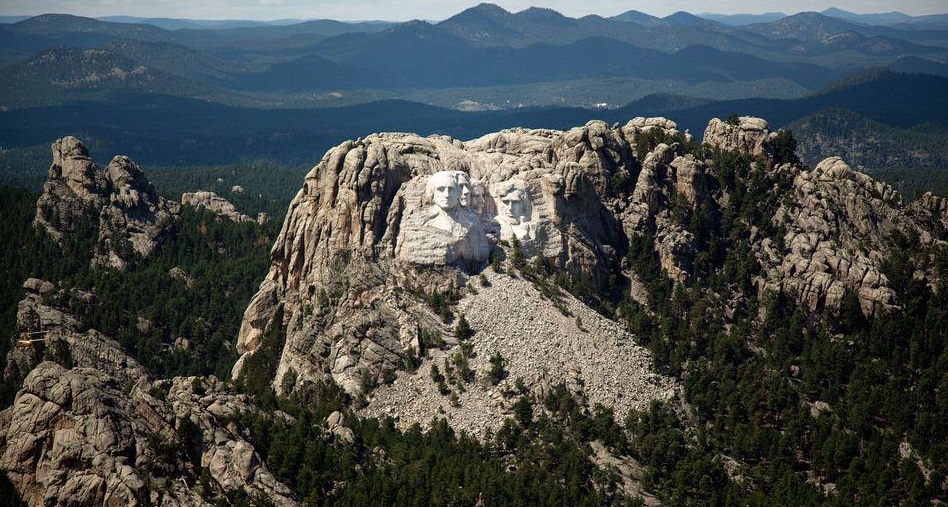
Subsequent to this, in 1885, Mount Rushmore was eventually renamed after wealthy NY lawyer Charles E. Rushmore. Then much later in the 1920s, state historian Doane Robinson began to propose the mountain as the ultimate opportunity for South Dakota to increase tourism through the Black Hills. The sculptor Gutzon Borglum was later hired to create a colossal monument to literally “honour the West’s greatest heroes, both Native Americans, and pioneers.” But Borglum preferred a Nationally significant monument and so eventually convinced state historians to only use the faces of U.S. notable presidents instead to symbolise the first 150 years of American history. He also rejected the originally designated site of naturally eroded rock columns called the ‘Needles’ . He claimed individual Western heroes would look like “making totem poles of these wonderful spires”. Native American groups, local historians, and civic leaders were deeply offended. But momentum was set and the new location shifted to the new Mount Rushmore, where the monument was soon to become an ultimate ‘Shrine of Democracy’ and one where Borglum famously declared, “America will march along that skyline”. Once complete, it was to feature the 18-meter granite faces of its four prominent U.S. presidents blasted and carved directly into a mountainside. Begun in 1927, its scope and procurement was naturally affected and compromised by first the Great Depression and then the Second World War, before being finally completed 14-years later in 1941.
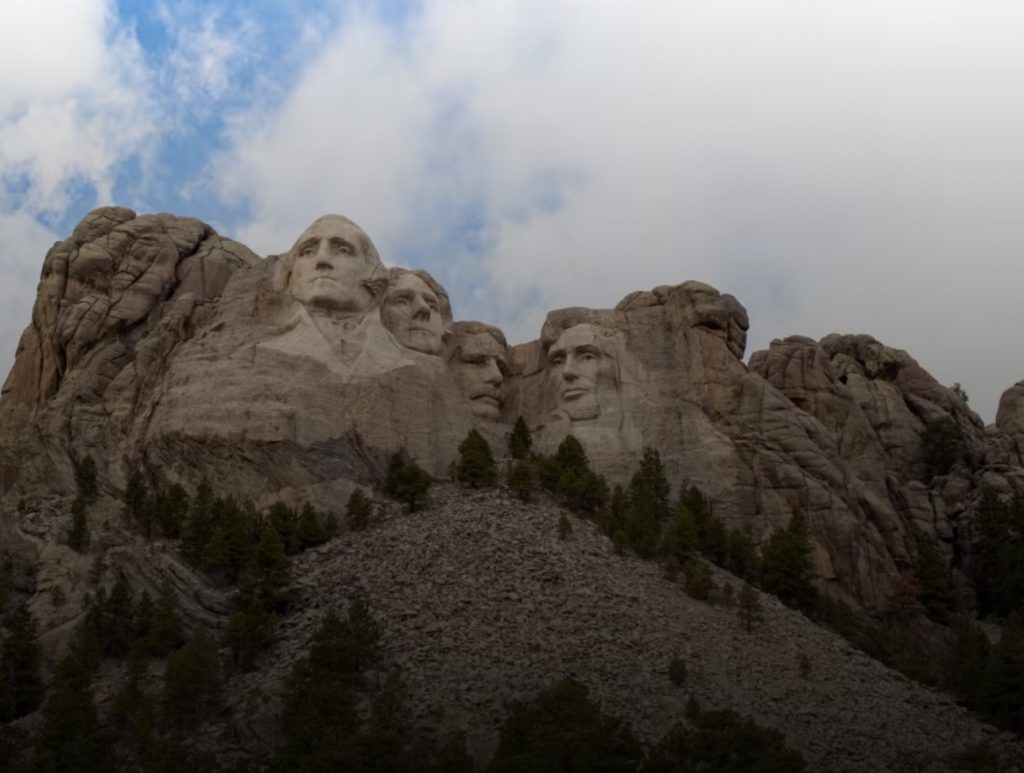
Counter Memorial: Crazy Horse on Thunder Mountain
After Crazy Horse had orchestrated his victory at Little Bighorn River on 25 June 1876, he later forced the U.S. to double its calvary on the Great Plains. After this, the Lakota, Cheyenne, and Arapaho warriors faced insurmountable odds in the years following. Known as The Great Sioux War, this intensified as the U.S. Army rounded up all indigenous tribes, forcing them to live on undesirable reservation lands. It ultimately led to the tragic, forced marches as part of the wider Trail of Tears of the 1830’s, where thousands of Native people died from cold, hunger, and disease.
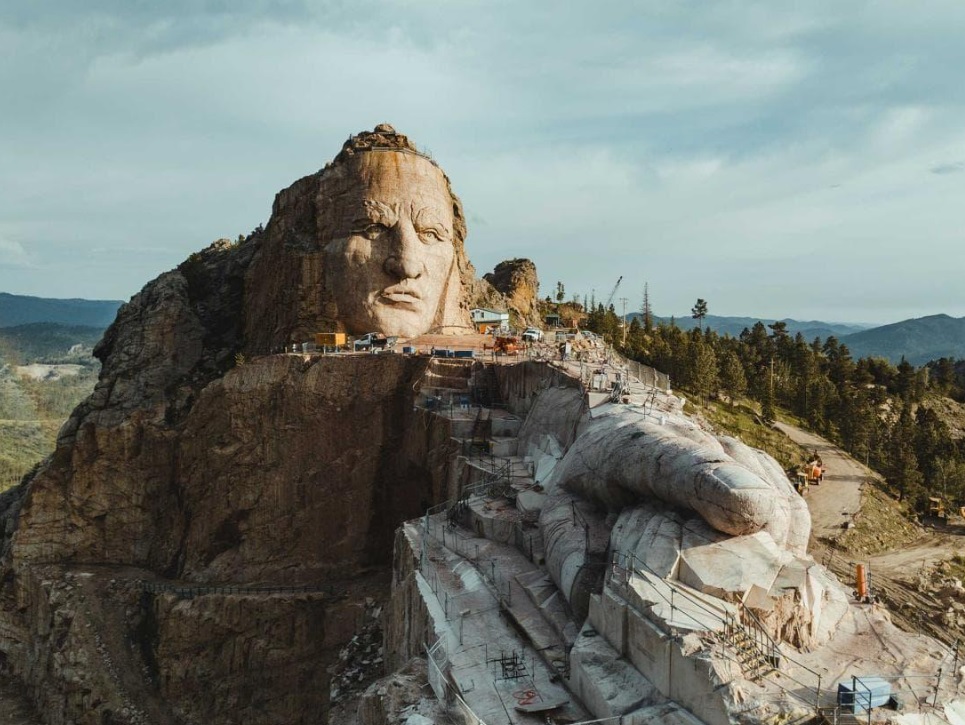
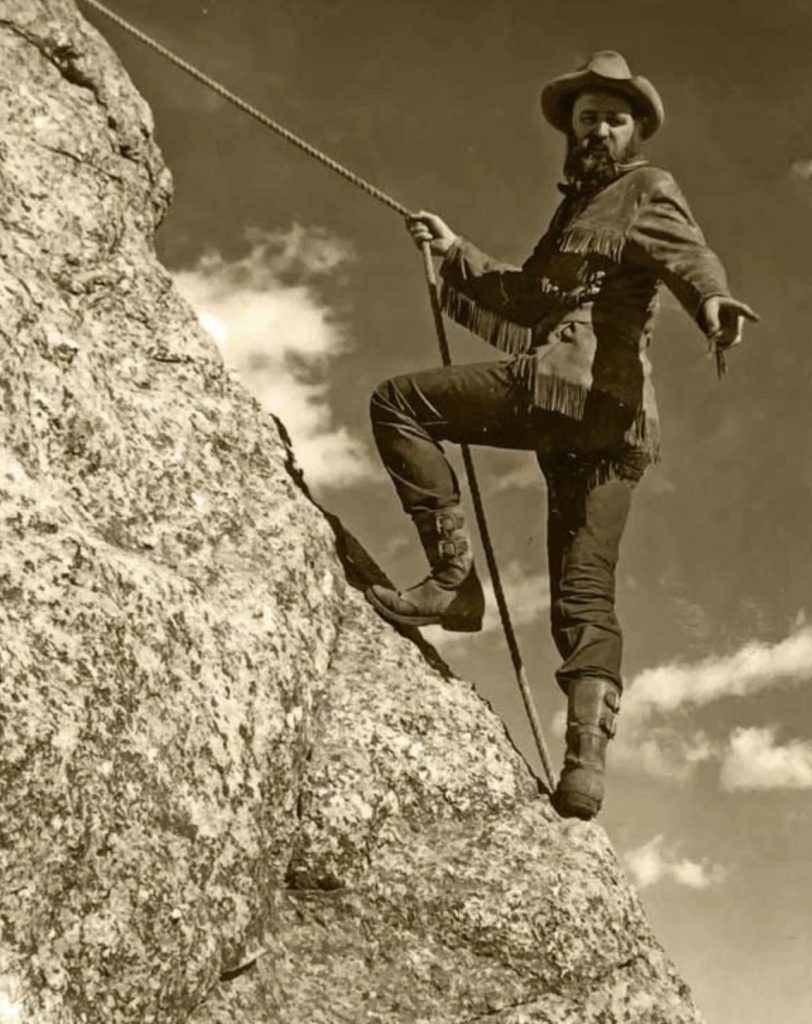
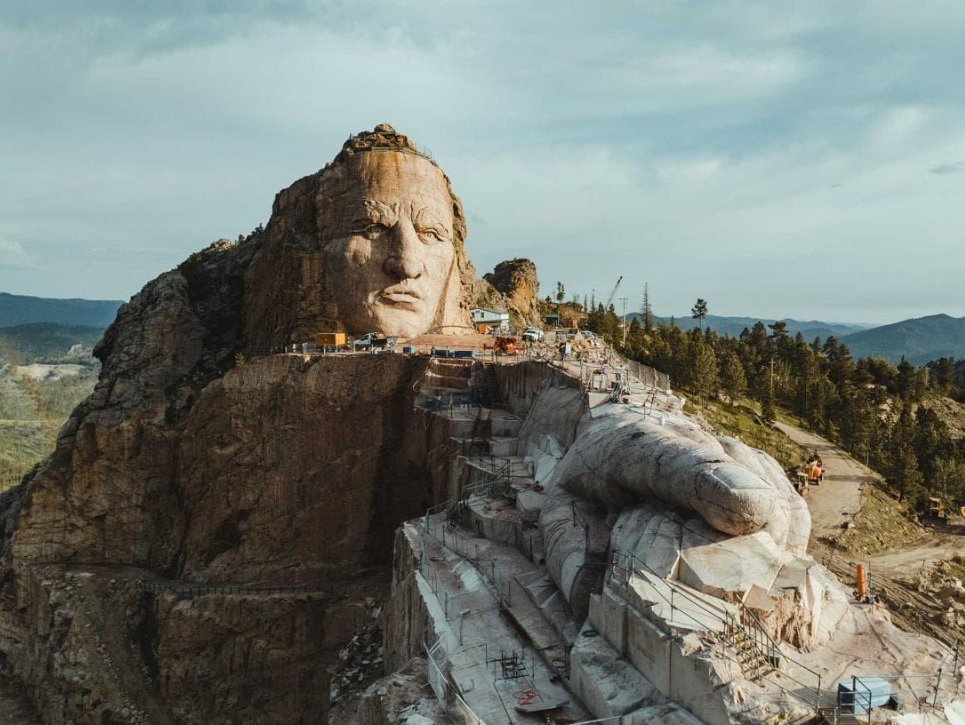
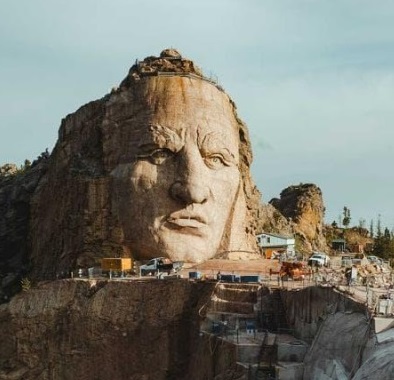
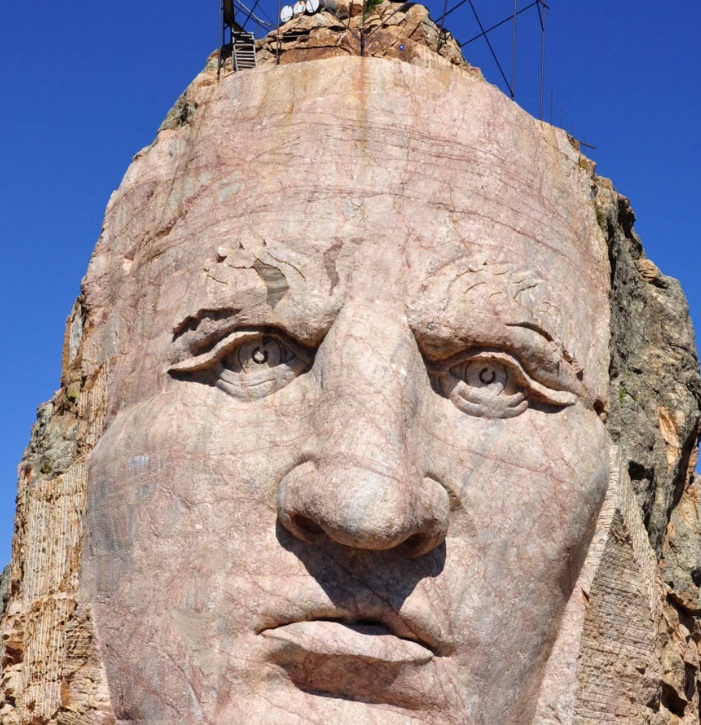
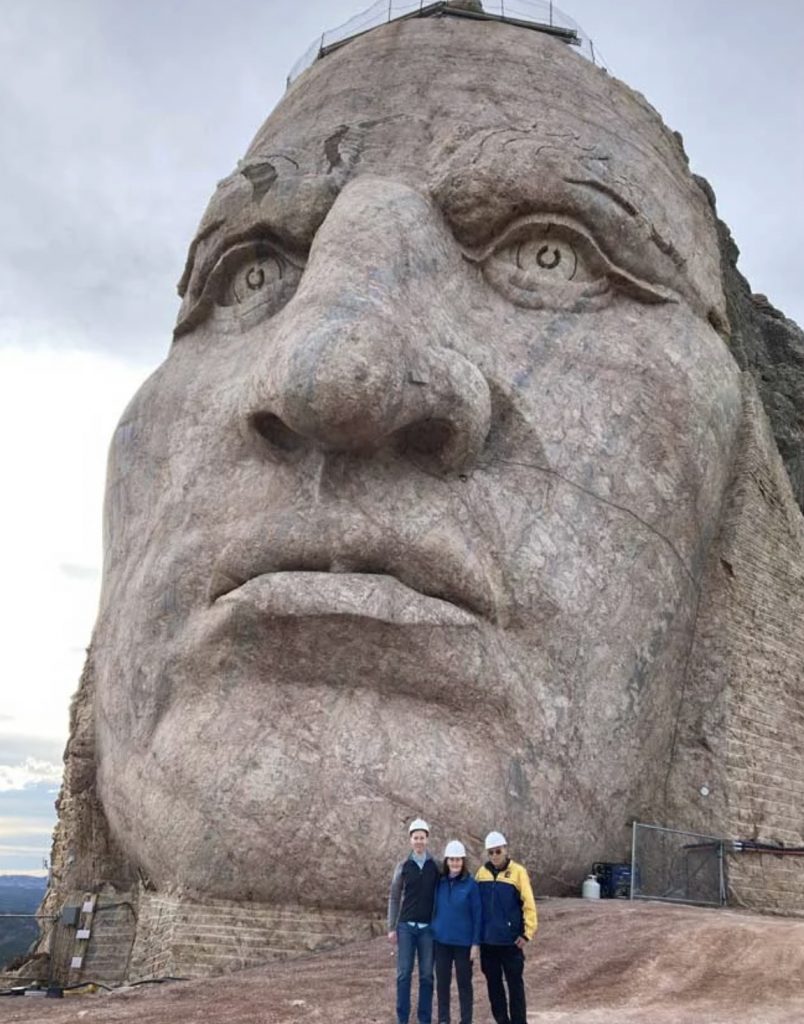
But it was Crazy Horse rather than Sitting Bull that remained the symbol of proud resistance. His name was passed down to him from his father – although his true Lakota name was actually Tȟašúŋke Witkó ( translating literally to “His-Horse-Is-Crazy”). So it was that by 1939, and just two-years before completion of Mount Rushmore, a Lakota Chief called Henry Standing Bear selected Crazy Horse as the ultimate symbolic figure to represent all Native American heroism and resistance. As such, he invited as artistic foil to Gutzon Borglum, the Polish American sculptor Korczak Ziółkowski, to start his ‘counter-memorial’ project. The brief set by Standing Bear was for Ziółkowski to carve a Native hero to contrast Mount Rushmore, explicitly stating he wanted the white man to know “the red man has great heroes, too”. His Crazy Horse Memorial was to depict the Oglala Lakota (one of the seven major bands of the Lakota nation) warrior riding his galloping horse, whilst pointing to his seized tribal lands.
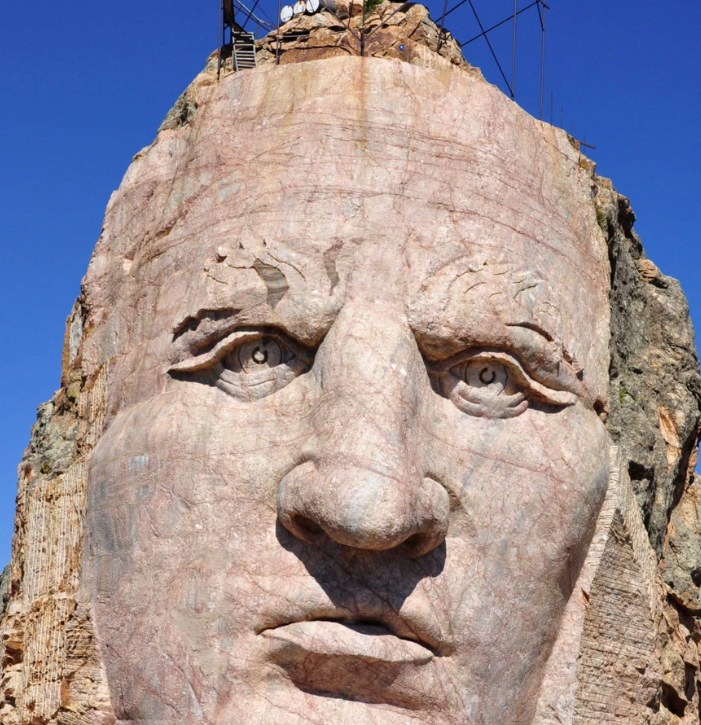
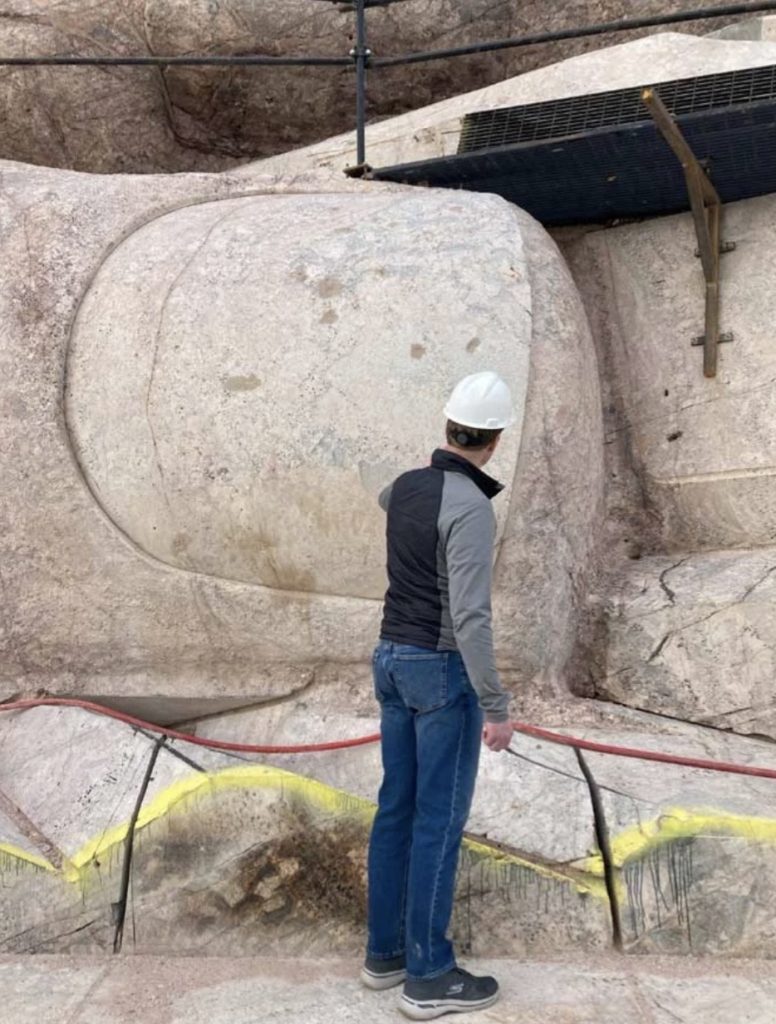
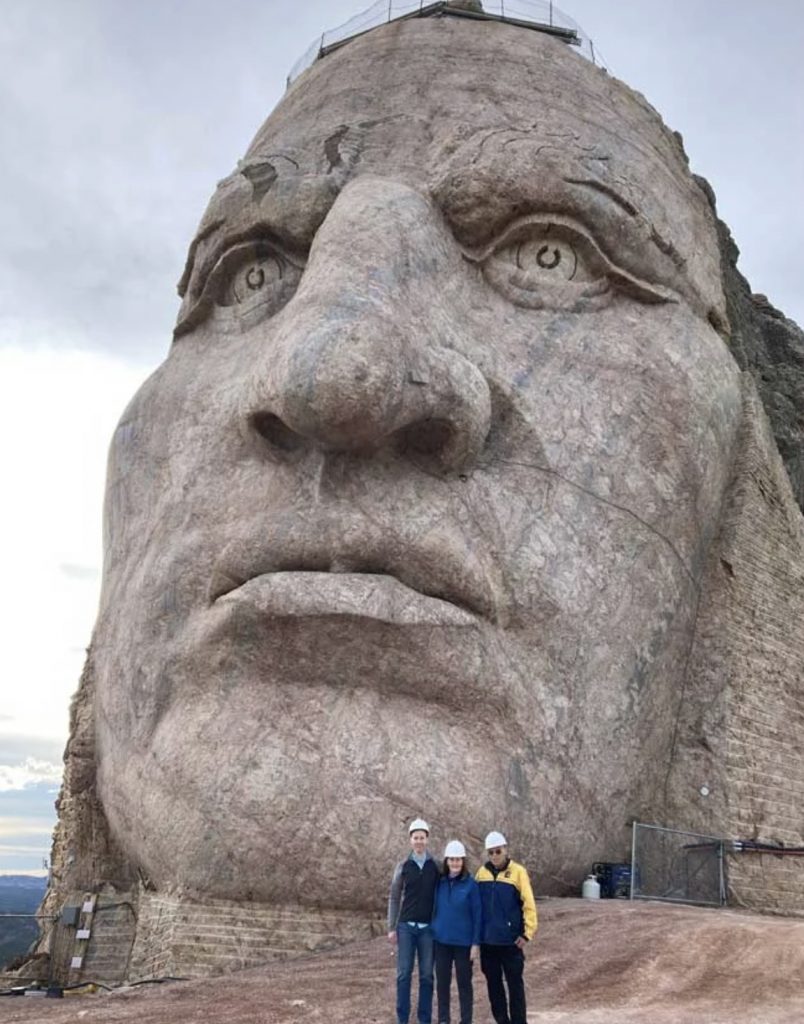
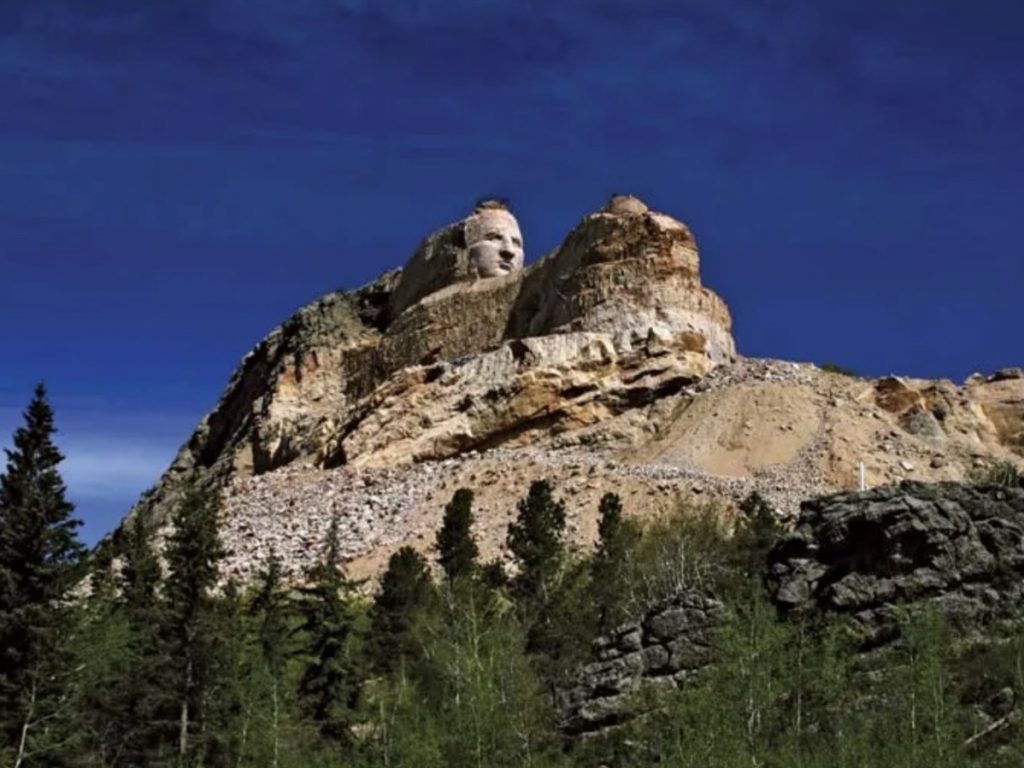
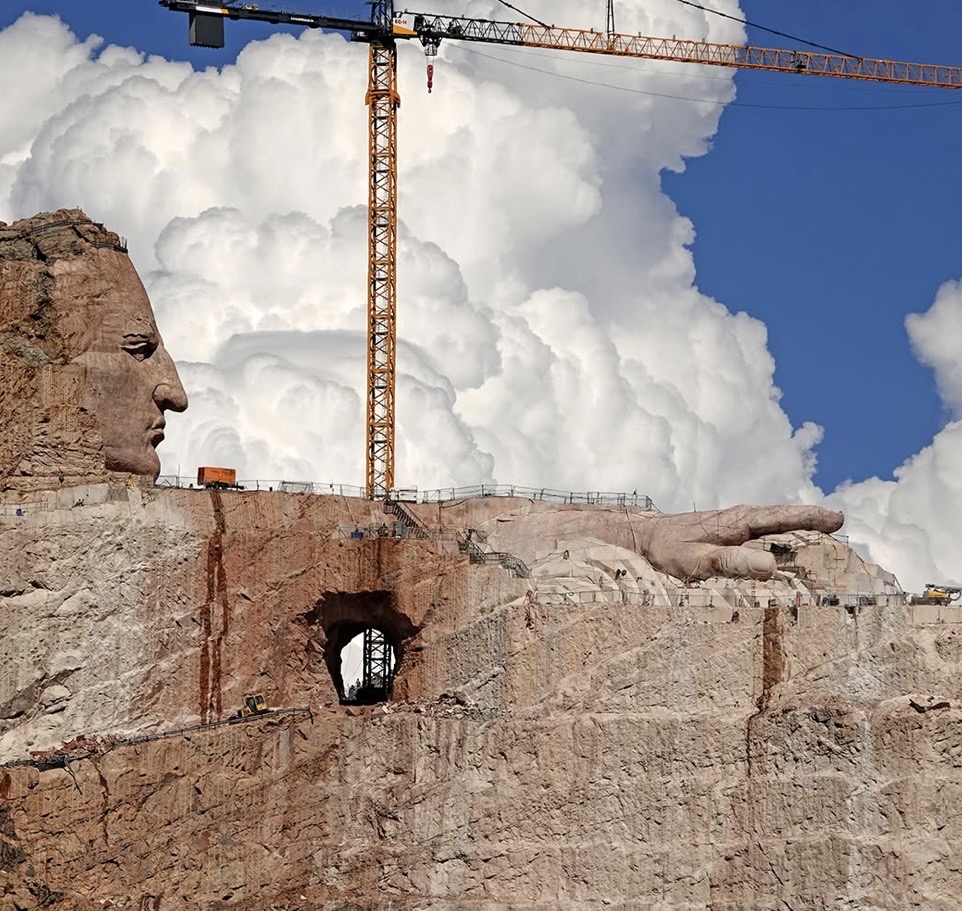
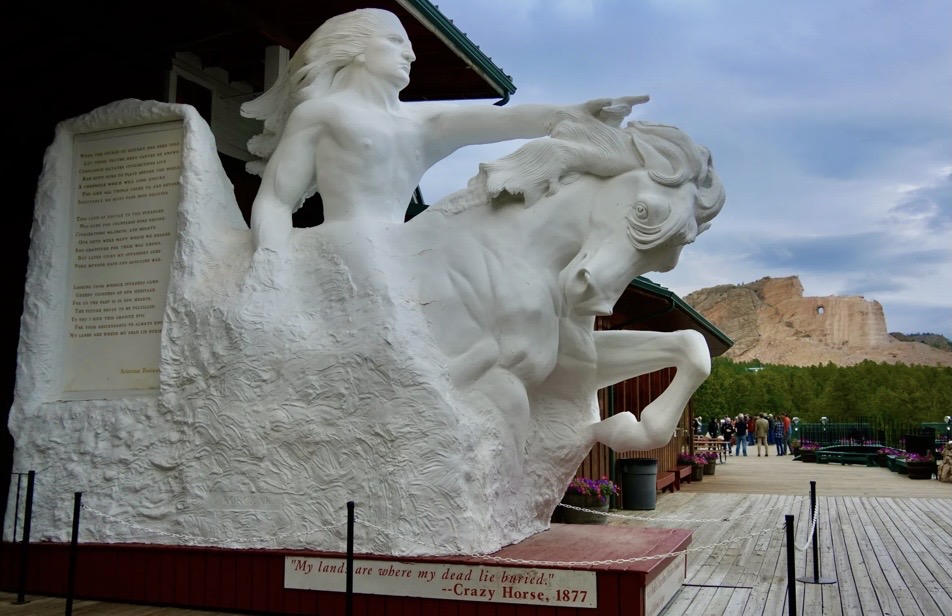
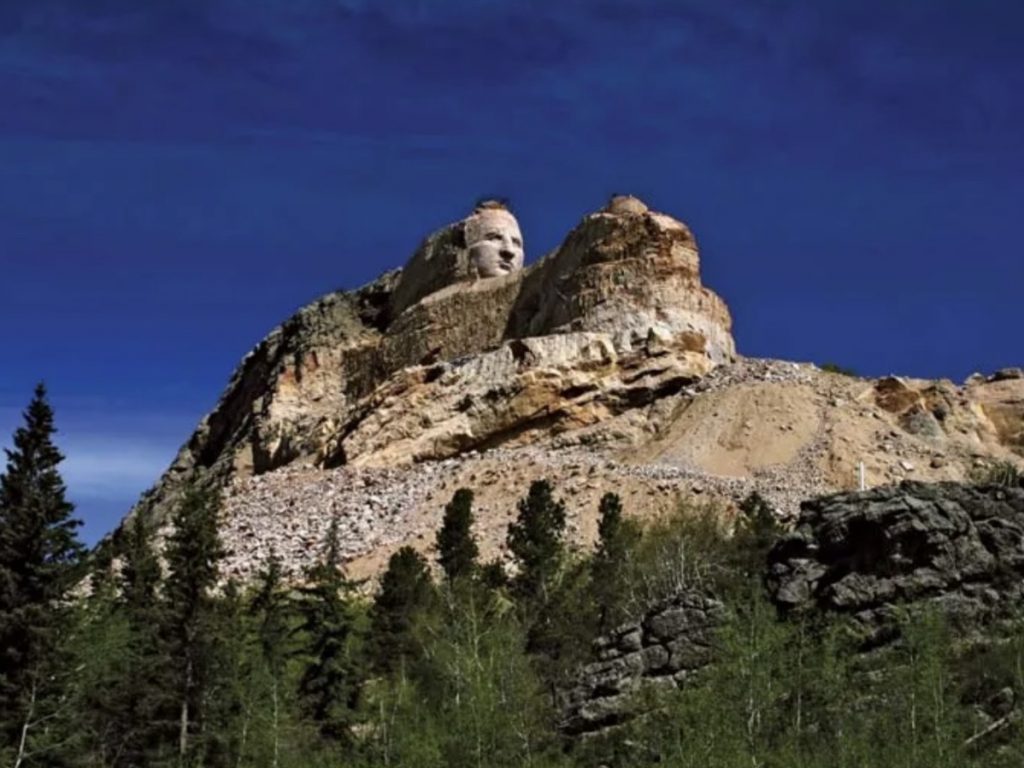
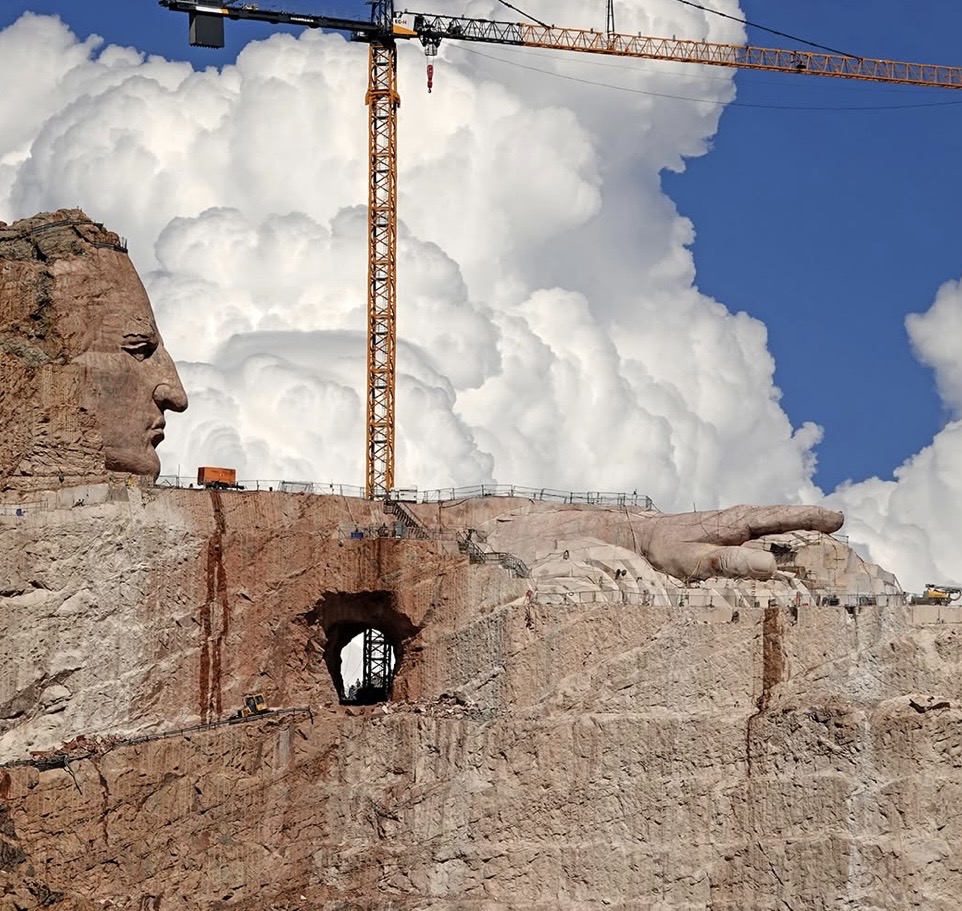
Thunderhead Mountain was eventually selected by Ziółkowski and Lakota elders in 1948 for its massive granite scale and its deeply embedded spiritual status. The sculptor’s final design portrays Crazy Horse emerging seamlessly from the rock, whist riding his steed and pointing outward. This posture immortalises his famous quote regarding his people’s enforced displacement: When asked by a victorious white man mockingly “Where are your lands now, Crazy Horse?” he replied, whist pointing across his spiritual lands of Pahá Sápa: “My Lands are where my dead lie buried.”
The mountain here was known as Thunderhead Mountain, long before mass stone blasting commenced, due to the heavy, dark storm clouds or thunderheads that frequently gather around its summit. In Lakota cosmology, Thunderhead Mountain is also considered a living deity as a sacred dwelling place for their Wakinyan (the Thunderbird or Thunder Beings). In ancient, indigenous tradition, thunder and lightning are seen as the voice and presence of this Wakinyan. These are their sacred winged guardians of the west bringing both life-giving rains and awesome destruction in equal measure. To them, because the sun sets in the west, this direction signified the close of day and the end of a life cycle. The Wakinyan hold intense sacred power in Sioux cosmology, representing their ultimate protective and elemental forces. These spirits naturally held an exceptionally personal connection to Crazy Horse too of course. As a youth, he reportedly went into the Black Hills to seek a vision. He was blessed by the Wakinyan who he claimed granted him supernatural protection in battle. He wore a sacred stone behind his ear and never allowed himself to be photographed, trusting entirely in this spiritual power.
Comparisons
Even if they share geology and historical provenance, the long completed Mount Rushmore and the still ongoing Crazy Horse Memorial on Thunderhead Mountain differ sharply in logistics, methods, timeframes, and funding of course: Mount Rushmore cost about $1 million ($14 million adjusted) using federal funds over 14 years, whereas Thunderhead is a private, multi-decade non-profit project relying on visitor revenue and donations without government money.
Mount Rushmore used 400 workers and dynamite for 90% of the rock removal from 1927 to 1941, stopping at the presidents’ heads due to funding. Thunderhead began in 1948 under sculptor Korczak Ziolkowski using similar granite blasting, but with an open-ended timeframe spanning generations, heavy modern equipment like cranes, and self-generated visitor centre and gift shop funds
The exact total cost spent on the Crazy Horse Memorial since 1948 is not publicly disclosed in a single master figure, as the project is privately managed by a non-profit foundation.
However, the Crazy Horse Memorial Foundation has accumulated circa $130 million in net assets and reportedly generates approximately $14.5 million in annual revenue. But it is often pointed out in response to critics that only a small portion of the millions raised each year directly goes into physical rock blasting. Millions of dollars are spent annually maintaining the on-site Indian Museum of North America, a satellite university campus.
Postscript
Today both memorials of Mount Rushmore and Thunderhead Mountain sit within the same geographic footprint as the Custer State Park reserve. Mount Rushmore sits just across the northern border in adjacent Pennington County whereas Thunderhead Mountain is located directly inside Custer County itself.
That they are both awesome examples of immense technical and sculptural ambition (especially with both started well before the digital age), cannot be disputed. The biggest question (still unresolved of course) is how the linked cultural appropriation and desecration of tribal lands will ever be adequately addressed and compensated – if ever.
For the Lakota people, Mount Rushmore is still viewed as a desecration of sacred land and a symbol of broken treaties, whilst Thunderhead Mountain, with its location of the Crazy Horse Memorial, originated from a cooperative Native-led effort to honour indigenous heritage is more accepted – albeit it still carries complex, mixed views within the broader tribal community regarding mountain carving generally on any spiritual land of the Pahá Sápa Black Hills.
To this day, many traditional Lakota—including some direct descendants of Crazy Horse himself—still vehemently oppose the Crazy Horse Memorial. Like their Six Grandfathers Mountain, they view the blasting of Thunderhead Mountain also with dynamite as the literal mutilation and destruction of a sacred site where the Wakinyan live. Native activist Russell Means famously captured this opposition by comparing the massive carving to carving up Mount Zion in Israel to honour Hebrew prophets.
In 1973 the so-called Wounded Knee Occupation, was a 71-day armed standoff where American Indian Movement (AIM) activists and local Oglala Lakota people seized the historic South Dakota town of Wounded Knee to protest tribal corruption and broken U.S. treaties like at Fort Laramie. Then, in a landmark 1980 case United States v. Sioux Nation of Indians, the Supreme Court ruled that the Black Hills were indeed stolen. The court awarded over $100 million in compensation. That the Lakota tribes have refused to accept the money for over 40 years is to their cultural credit – they state that the land was never for sale and demanding its physical return instead.
Today, both Custer and Crazy Horse are remembered and celebrated: Each September marks the annual Custer State Park Buffalo Roundup & Arts Festival, which takes place just south of the national monument of the Little Bighorn Battlefield. Custer State Park is South Dakota’s first, largest, and most celebrated state park and wildlife reserve, spanning over 71,000 acres of wilderness nestled in the Black Hills and primarily located within Custer County. Geographically slightly separate, but linked to this under unified regional tourism strategies, the Crazy Horse Memorial Blast Night also lights up Thunderhead Mountain annually on 6 September with fireballs and pyrotechnics – on sculptor Korczak Ziółkowski’s birthday, perplexedly. This is followed later in September too with the Native American Day celebrations of traditional dance, song, and art – also hosted at the Crazy Horse Memorial.
Fast-forward, the questions remain of course, will the Crazy Horse Memorial ever be finished and will Trump ever get his way to force through his own ultimate presidential effigy?
The jury is still out on the latter. But with National Parks Service experts reported as saying that geological fractures in the rock and engineering constraints make carving an additional President’s face practically impossible, there is hope his posturing will go no further.
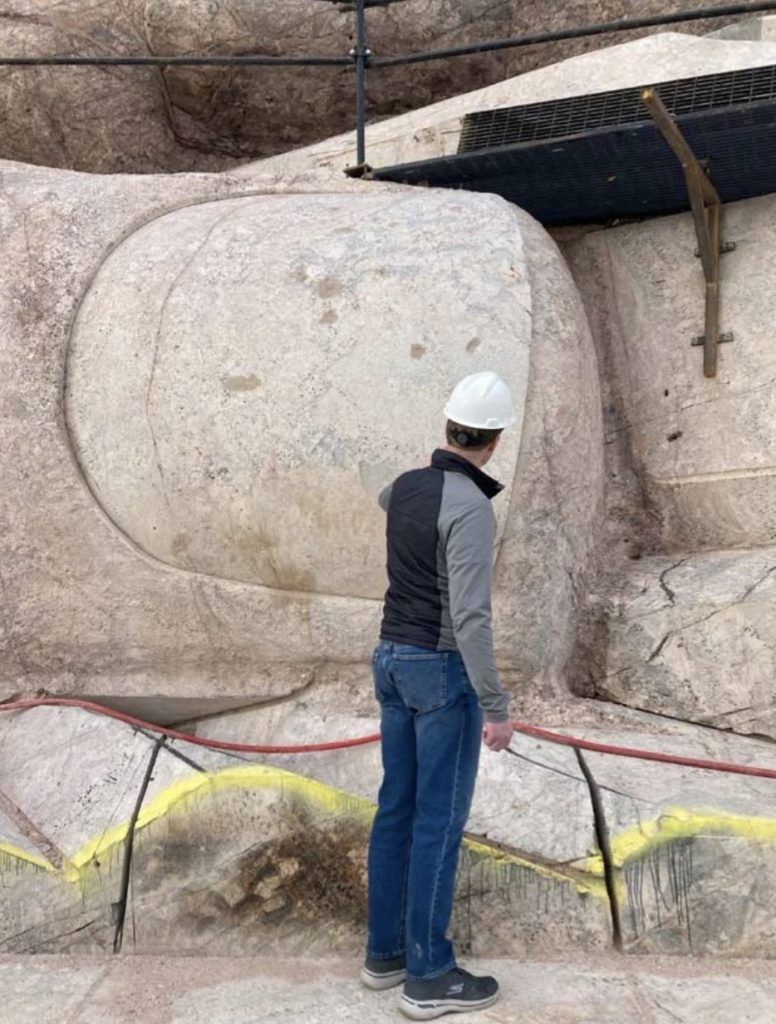
The prospect for Crazy Horse Memorial is most positive perhaps, although the most complex aspects of the project (his huge horses head, leg and tunnelled undercuts) are largely un-started after 78 years. Let us hope the accumulated assets and income of the Memorial Foundation continue to prosper. However, with current U.S federal debt sitting near $39.75 trillion, weighed against an annual Gross Domestic Product of roughly $32 trillion – as well as imminent inflation and downturn in the offing, public appetite for the charitable endeavour may also begin to dwindle.
As for the outcome of the Supreme Court ruling in favour of the Sioux Nation of Indians, I guess only time will tell. But the moral high ground (literally the whole of Pahá Sápa Black Hills) is theirs.
But in the end, the main elemental difference between Donald Trump and Crazy Horse, other than the glaringly obvious ones, is that whilst Trump is the boorish United States President, born with gilded entitlement and wealth, he still desperately seek plaudits and garners attention through his constant craving for publicity and praise. In stark contrast, Crazy Horse was a self-effacing great man, leader and figurehead of a nationally persecuted indigenous nation, but who personally eschewed all personal attention and fanfare throughout his life, as well as at the very height of his fame. If this were another battle, Crazy Horse would again defeat his new age “Yellow Hair” hands-down.
It is of course well-documented that, unlike Narcissus Trump, there are no known photographs of Crazy Horse (although there are many of Sitting Bull and other Chiefs). When once asked if he could be photographed, he famously replied to the photographer: “My friend, why should you wish to shorten my life by taking from me my shadow?”
Clearly, only when you are blessed by the Wakinyan Thunderbird, is true leadership and immortality guaranteed.
Categories: Journaling