Atoll journal uploaded 12 August 2026 revisits and explores both the phenomena of the often irreverant but highly bankable street artist Banksy and the artistic, moral and architectural issues his ongoing portfolio of guerrilla grafitti and artworks raises. Ian’s original Banksy article Existencillism first featured in December 2005’s issue 27 of ‘Prospect NW’, a monthly magazine for RIBA NW, published by the Carnyx Group. The features were part of a monthly series of ‘introductions to public art’ written by Ian, then the Public Art & Architecture Officer for Arts Council England NW. An earlier article from 2020 Power ot the People discussed the morals around artist Marc Quinn’s “ambush sculpture” called ‘A Surge of Power (Jen Reid) 2020’ installed surripticiously overnight following the toppling of the slaver Edward Colston into the Bristol docks.
As well as featuring on Substack, this latest article was also submitted to the RSA (Royal Society for the Encouragement of Arts, Manufactures and Commerce) Fellows Circle – a global online community platform designed for Fellows to connect, collaborate and learn from one another. Ian has been a Fellow of the RSA since November 2012. For more than 270 years, the RSA has been a charity dedicated to creating a better future. To bring together ideas, research and practical action to tackle society’s biggest challenges, helping turn bold thinking into lasting impact.The common good is what gives creativity purpose.
Street Art or Crime?
It has been a while since I last wrote an piece about our beloved guerrilla artist Banksy (fair to say given my age, that I have probably held the same nickname as him for far longer, but we are no known relations). I last wrote about him in 2005, comparing his anarchic work then with that of the stencilled art (Pochoir) explosion in France prior to the 1968 student uprising. Of course, at the time of writing that, his political oppressor of the day was the New Labour of Tony Blair – so not quite the same levels of State oppressior.
Today many UK councils now enforces stricter zero-tolerance approach toward all unauthorised graffiti, tagging, and fly posting, viewing it as environmental blight and antisocial behaviour . Councils like Westminster, even commit to removing offensive or hate-related graffiti within 12 hours of notification, and standard graffiti or markings on public property or street furniture within three working days
This is interesting then, as it has been recently reported in the press that three Banksy ‘guerrilla artworks’ have so far cost us UK taxpayers in the region of £150,000 in related removal works, security and other costs. The costs are expected to increase further. The biggest cost of these relates to his stencil mural painted on the Royal Courts of Justice in London, a Grade II-listed building on Carey Street, in September last year. Some reports say that the costs to remove it and provide security around it have cost in excess of £85,000 for that one street artwork alone. The Ministry of Justice told the BBC, after their submitted freedom of information request, that £50,000 was spent by Westminster Council itself trying to remove the paint from the wall, with an additional £35,000 cost for overtime and security.
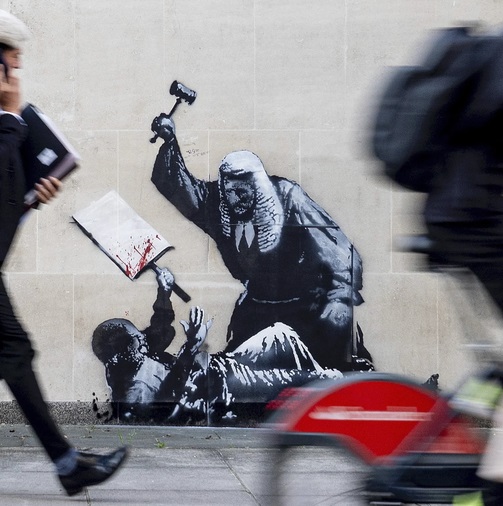
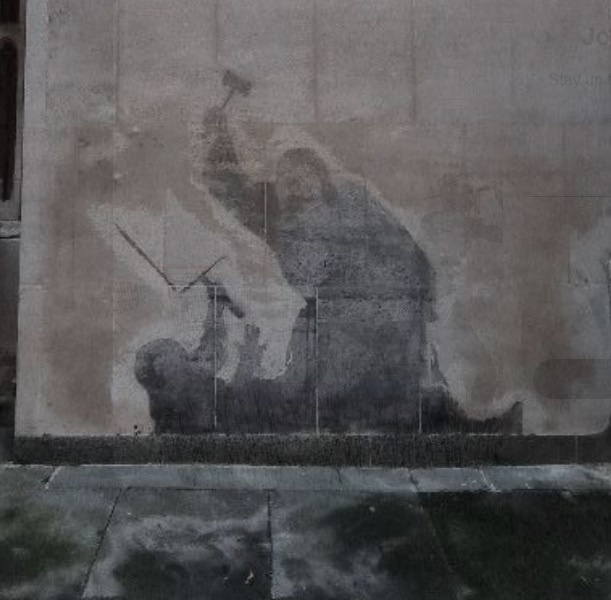
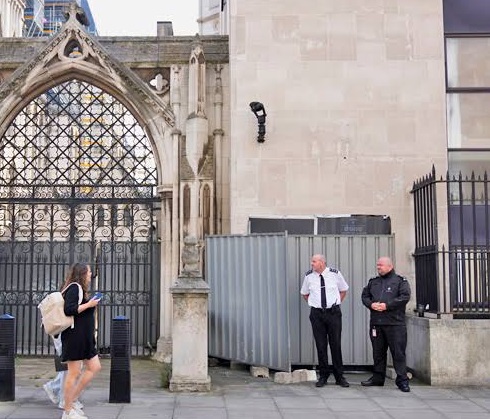
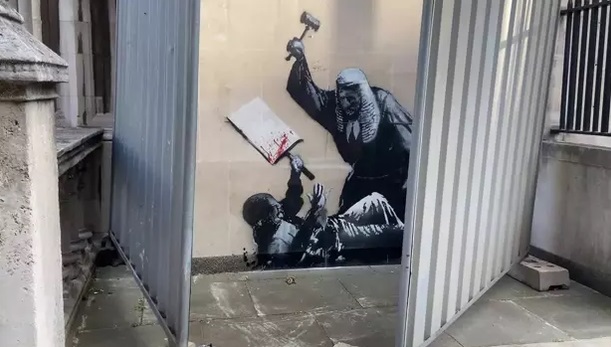
If you are not familiar with it, the graffiti installation depicted a judge in a wig beating a protester with his gavel. Banksy had confirmed it was his when he posted an image of it on his website and Instagram account. It was said by some that the work may have been in response to the arrest of 890 protestors at a demonstration against the UK government’s ban on the group Palestine Action earlier in 2025.
So what should we make of the ongoing populism of the work of street artists like Banksy, when we consider, his continuing rights of anonymity, free speech and artistic freedom set against simple legal practicalities and implications that the rest of us must presumably keep to?
Technically in the UK, unauthorised guerrilla street art and graffiti remains strictly illegal and can be treated as criminal damage or antisocial behavior, regardless of the creator’s artistic intent. The vital legal distinction is permission, Painting or marking any public or private property without the owner’s explicit consent is classified as vandalism. Unauthorized graffiti can theoretically be prosecuted under the Criminal Damage Act 1971 or Anti-social Behaviour Act 2003 & Anti-social Behaviour, Crime and Policing Act 2014. Depending on the financial cost of the damage, penalties can range from fixed penalty notices and community service to even prison sentences of up to 7 years (or even 10–14 years for aggravated or racially/religiously aggravated criminal damage). Otherwise, Local councils and the police can issue their Fixed Penalty Notices, Community Protection Notices or Criminal Behaviour Orders for environmental damage and tagging.
The Guardian reported that art critic Estelle Lovatt had defended the recent work in Westminster, even highlighting the benefits to cultural tourism. “Some people visit Buckingham Palace and others visit Banksy’s art,” she had told the BBC recently.
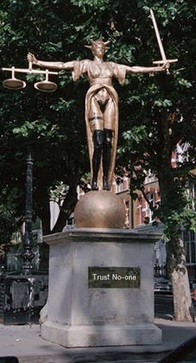
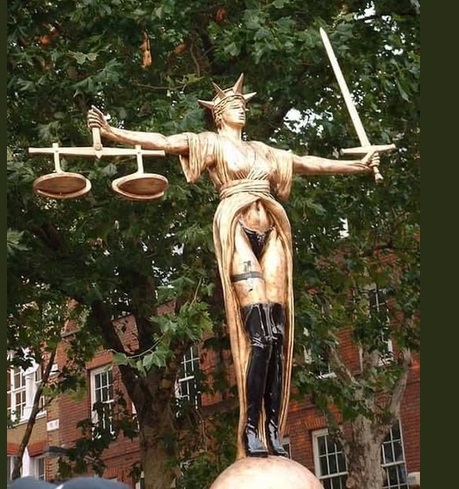
For his part, Banksy of course has long had anti-Establisment ‘previous’: in 2003 he had illegally sited his pop-up solid bronze statue of “Lady Justice”, dressed as a prostitute wearing black thigh boots and a thong, with US dollar bills stuffed into her garter and a plaque on the plinth saying: “Trust no-one.” He called it his “brand new monument for London” and it was he said: “dedicated to thugs, to thieves, to bullies, to liars, to the corrupt, the arrogant and the stupid.” It was timed to coincide with the first anniversary of the death of Kevin Callan, a lorry driver who was the victim of a miscarriage of justice when wrongly convicted in 1991 for the murder of a four-year-old. His conviction had been overturned in 1995.
Many neighbouring boroughs to Westminster (like Tower Hamlets, Southwark, and Lambeth) today operate under similar swift-removal guidelines for unauthorised tagging. However some areas of London (like Shoreditch, Camden, and Brixton) feature more informally tolerated or even legally designated mural zones where landowners have given blanket consent for street art to flourish.
Similarly, home town of Banksy no less, the city of Bristol also views its street art as a core part of its cultural identity rather than as a crime. Bristolians treat their public painting with deep local pride, official tolerance, and active community support even. This open attitude turns neighbourhoods into open-air galleries and makes the city the unofficial capital of UK street art, with popular cultural tourism tours marketed to view them.
It is a difficult cultural question and dilemma to address in our public realm today, and one where Banksy (with the extra column inches and sell-on costs he can easily generate) is given arguably far more leeway than other transgressing street artists.
But in the meantime let’s allow the final word to the maestro himself: Banksy once stated on his website that “People look at an oil painting and admire the use of brushstrokes to convey meaning. People look at a graffiti painting and admire the use of a drainpipe to gain access”.
The jury is still out on this one.
POSTSCRIPT: My Use of Artificial Intelliegence.
I currently write the majority of my own journal pieces, but with the assistance of search engines, and increasingly AI, to research & check key information and weblinks quickly. In some cases, (typically where time constraints, subject complexity & lack of available free time is against me running my solo architect business at 65), I do sometimes co-author works with AI (typically ChatGPT, but Gemini occasionally). On all of all these occassions, credit where credit is due, this is clearly confirmed by me at the head of each article or journal. I do this though openly and in the spirit of creative (non-human) colllaboration!
In undertaking this deliberate creative experiment, I am a big subscriber to the book ‘Scary Smart: The Future of Artificial Intelligence and How You Can Save Our World‘ by author Mo Gawdat, a previous chief business officer for Google X. In it, Gawdat highlights how AI must learn from us like a child, saying: “Children don’t learn from what you say. They learn from what you do“. My attitude to AI is also that it is the inevitable way of the future – just like the fledgling railway industry was over 200 years ago.
Categories: Journaling